Top 10 Horse Riding Clothing Manufacturers in China (2026)
Compare the top 10 horse riding clothing manufacturers in China by product specialization, MOQ, pricing, lead times, and quality standards. Discover how to evaluate suppliers, avoid sourcing risks, and choose the right manufacturing partner for your equestrian apparel brand.
Top 10 Horse Riding Clothing Manufacturers in China: Supplier Comparison & Buying Guide (2026)
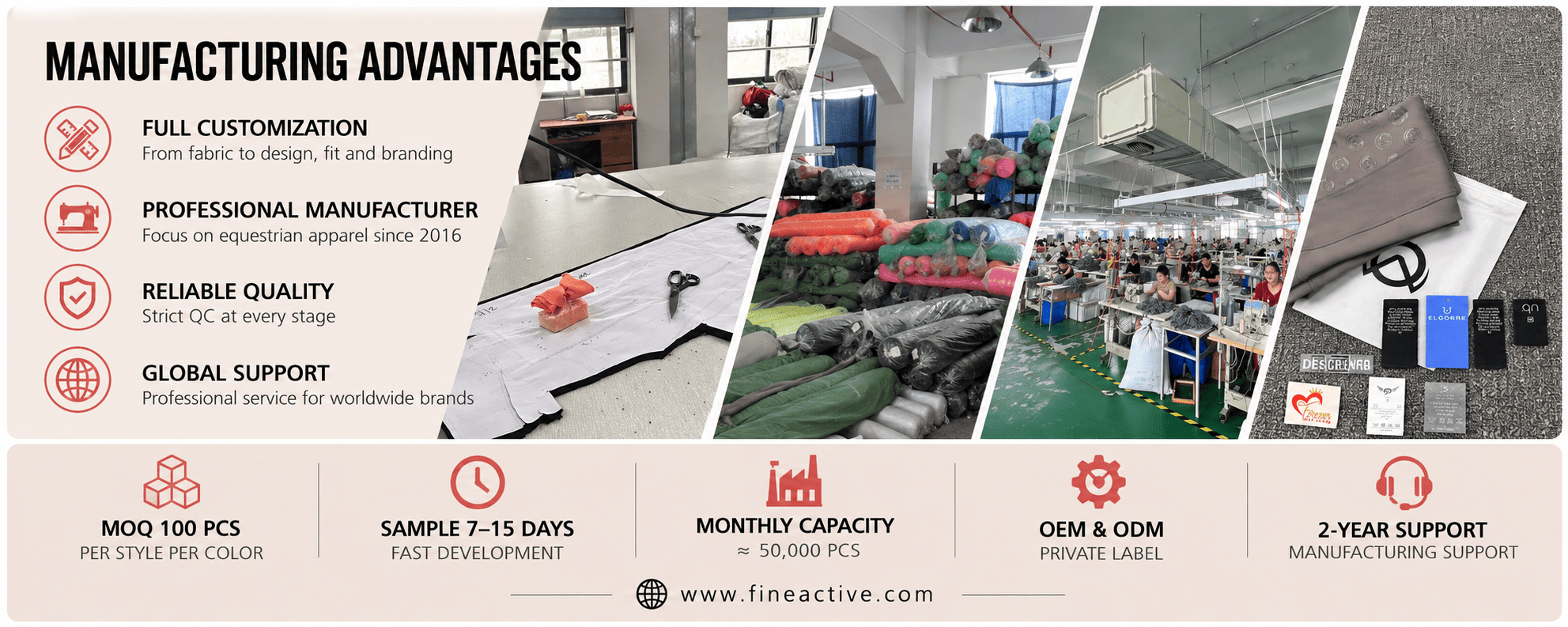
Choosing a horse riding clothing manufacturer in China involves more than comparing prices or browsing product catalogs. For equestrian brands, the wrong supplier can lead to inconsistent sizing, unreliable deliveries, unexpected production costs, and quality problems that affect customer confidence.
China offers a wide range of equestrian apparel suppliers, from factories specializing in riding breeches and competition clothing to multi-category sportswear manufacturers and broader equestrian product companies. However, their strengths, minimum order requirements, production capabilities, and suitability for different buyers can vary considerably.
Which are the top horse riding clothing manufacturers in China? Ten suppliers worth comparing in 2026 are Fineactive, SGL Sports, Zest Equestrian, Equifactory, Kala Apparel, RunEquestrian, Shuyu Activewear, RW Equestrian, Hubei KDL Equestrian Products, and OpeEquestrian. Each represents a different sourcing option, and no single manufacturer is automatically the best choice for every brand.
This guide compares these suppliers by product specialization, MOQ, lead times, publicly available manufacturing information, and purchasing suitability. It also explains how to verify factory credentials, evaluate quotations, identify sourcing risks, and select a manufacturer based on evidence rather than marketing claims.
Whether you are launching an equestrian clothing brand, expanding an established collection, or reviewing your current supply chain, this comparison will help you build a more informed supplier shortlist.
1. Who Are the Top 10 Horse Riding Clothing Manufacturers in China?
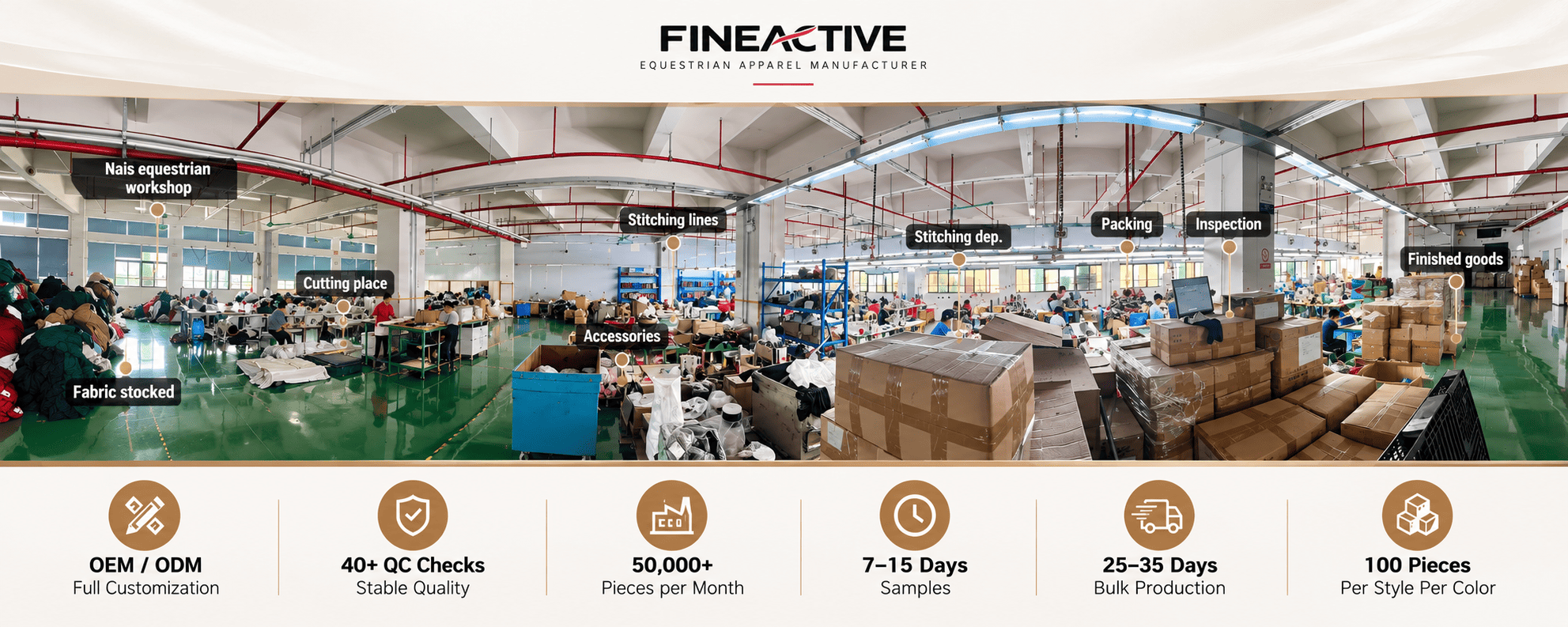
The top horse riding clothing manufacturers in China include equestrian apparel specialists, multi-category performance clothing factories, and suppliers serving both riders and horses. Fineactive, SGL Sports, Zest Equestrian, Equifactory, Kala Active, RunEquestrian, Shuyu Activewear, RW Equestrian, Hubei KDL, and OpeEquestrian are ten companies worth comparing for a 2026 supplier shortlist.
Their differences matter more than their position on a list. Some focus on riding apparel, others combine equestrian clothing with general sportswear, while several offer horse equipment alongside garments. The following comparison highlights their publicly available business information, product positioning, and potential suitability for different purchasing requirements.
Top 10 Chinese Horse Riding Clothing Manufacturers — Comparison Table
| Manufacturer | Location | Main Product Focus | Published MOQ | Best-Fit Buyer |
|---|---|---|---|---|
| 1. Fineactive | Dongguan, Guangdong | Specialized riding apparel | 100 pcs/style/color | Equestrian clothing brands |
| 2. SGL Sports | Dongguan, Guangdong | Riding clothing and sportswear | 200 pcs/design/color on selected products | Multi-category apparel brands |
| 3. Zest Equestrian | Guangdong, China | Rider clothing and horse products | From 200 pcs on its equestrian clothing offer | Equestrian retailers and distributors |
| 4. Equifactory | Wuhan, Hubei | Riding apparel and equestrian products | Flexible; product-dependent | Brands and riding clubs |
| 5. Kala Active | Dongguan, Guangdong | Equestrian wear and performance clothing | Product-dependent | Boutique and developing brands |
| 6. RunEquestrian | Guangzhou, Guangdong | Breeches and competition apparel | From 100 pcs on published offers | Riding apparel specialists |
| 7. Shuyu Activewear | Dongguan, Guangdong | Riding wear and technical activewear | Product-dependent | Sportswear and equestrian brands |
| 8. RW Equestrian | Dongguan, Guangdong | Breeches, riding tops and outerwear | From 100 pcs on selected listings | Multi-season apparel buyers |
| 9. Hubei KDL Equestrian Products | Hubei Province | Equestrian clothing and related products | Product-dependent | Broader equestrian sourcing teams |
| 10. OpeEquestrian | Dongguan, Guangdong | Riding apparel and horse products | Product-dependent | Apparel and equestrian product buyers |
MOQ figures reflect published offers where available, rather than guaranteed minimums for every garment. The order of companies is a comparison sequence, not an independently audited ranking of factory performance.
1.1 Fineactive — Equestrian Apparel-Focused Manufacturing
Location: Dongguan, Guangdong
Manufacturing history: Since 2016
MOQ: 100 pieces per style per color
Sampling: 7–15 working days
Bulk production: 25–35 working days
Fineactive specializes in equestrian clothing for international brands, with a product range covering riding breeches, riding tights, competition shirts, show jackets, base layers, and outerwear.
Its distinguishing feature in this comparison is its focus on clothing worn by riders rather than a broader catalog of horse equipment.
For buyers, that specialization may be relevant when developing a coordinated apparel collection or maintaining consistent products across repeat orders.
Competitive strengths
Dedicated equestrian apparel product focus.
Published MOQ and production timelines.
Product coverage across training, competition, and seasonal riding clothing.
Suitable for brands seeking a continuing apparel manufacturing relationship.
Potential limitations
Fineactive is not intended as a consolidated supplier for saddles, helmets, boots, or other horse equipment. Its standard MOQ may also be unsuitable for very small customized orders.
Best suited for: Startup and growing equestrian clothing brands, private label riding apparel businesses, and buyers prioritizing specialized garment manufacturing.
Buyers who want to evaluate Fineactive’s individual production terms can review its horse riding clothing manufacturing capabilities. Brands evaluating a specialized supplier can explore Fineactive’s equestrian apparel manufacturing capabilities for additional information.
1.2 SGL Sports — Equestrian Clothing and Performance Sportswear
Location: Dongguan, Guangdong
Published MOQ: 200 pieces per design per color on selected products
Sampling: Approximately 10 working days
Bulk production: Approximately 35–40 days
SGL Sports manufactures equestrian clothing alongside yoga wear, activewear, jackets, and other performance garments.
Its equestrian range includes riding breeches, leggings, base layers, riding shirts, and jackets.
Compared with apparel-only equestrian specialists, SGL Sports offers broader sportswear manufacturing experience, which may be useful for brands selling riding clothing alongside fitness or lifestyle products.
Competitive strengths
Broad technical sportswear product range.
Published development and production timelines.
Experience across several stretch-apparel categories.
Potential for coordinating equestrian and general activewear collections.
Potential limitations
The company’s broader sportswear focus means buyers should evaluate riding-specific garment experience separately. Published minimum quantities may also be less suitable for small multi-color launches.
Best suited for: Established sportswear brands, multi-category retailers, and buyers developing equestrian clothing alongside other athletic apparel.
1.3 Zest Equestrian — Rider Apparel and Broader Equestrian Sourcing
Location: Guangdong, China
Published experience: More than 16 years
Published MOQ: From 200 pieces on its equestrian clothing offer
Zest Equestrian serves the wider equestrian market, supplying rider apparel alongside products such as saddle pads, horse rugs, halters, and accessories.
Its broader product assortment distinguishes it from factories that concentrate exclusively on garments.
For retailers and distributors, this range may simplify sourcing across several equestrian categories.
Competitive strengths
Combination of rider clothing and horse-related products.
Broad equestrian product assortment.
Published experience serving international equestrian markets.
Relevant to retailers managing multiple product categories.
Potential limitations
Buyers focused entirely on clothing should establish which garment processes are handled directly and which involve production partners. Minimum quantities and timelines may differ significantly between apparel and horse products.
Best suited for: Equestrian retailers, distributors, tack shops, and brands purchasing clothing together with other equestrian goods.
1.4 Equifactory — Equestrian Collection Development and Supply
Published contact location: Wuhan, Hubei
Published experience: More than 20 years
MOQ: Flexible, depending on product
Equifactory supplies riding clothing and related equestrian products for brands, retailers, and riding clubs.
Its advertised range includes breeches, show shirts, riding jackets, base layers, and outerwear.
The company emphasizes collection development and technical garment production. Its public materials also describe a manufacturing operation with multiple production lines.
Competitive strengths
Broad riding apparel assortment.
Experience positioning focused on equestrian collections.
Relevant product categories for training and competition clothing.
Potential suitability for coordinated club and retail ranges.
Potential limitations
Published experience and production capacity should be evaluated against the specific facility assigned to an order. Flexible MOQ positioning does not establish a single minimum across every garment.
Best suited for: Equestrian brands, riding clubs, and retailers seeking several riding clothing categories from one supplier.
1.5 Kala Active — Equestrian Clothing and Boutique Apparel Development
Location: Dongguan, Guangdong
Published experience: More than 10 years
MOQ: Depends on garment specifications
Dongguan Kala Active manufactures equestrian clothing and other apparel categories, including sportswear, golf wear, western wear, and lifestyle clothing.
Its website presents design, sampling, fitting, sewing, and quality inspection as parts of its manufacturing offering.
Compared with narrowly specialized equestrian suppliers, Kala Active has a broader apparel development focus.
Competitive strengths
Experience across multiple apparel categories.
Product development and sampling support.
Equestrian clothing included in its core range.
Potential relevance for brands combining riding wear with lifestyle products.
Potential limitations
Buyers should confirm MOQ and production conditions for each garment rather than assuming that small-batch terms apply to every custom order.
Best suited for: Boutique equestrian labels, developing apparel brands, and businesses combining riding clothing with lifestyle collections.
1.6 RunEquestrian — Riding Breeches and Competition Clothing
Location: Guangzhou, Guangdong
Published experience: Since 2009
Published MOQ: From 100 pieces per style
RunEquestrian focuses on equestrian apparel, including riding breeches, jodhpurs, show jackets, competition clothing, and teamwear.
Its product positioning makes it relevant to brands seeking a supplier familiar with riding-specific garment categories rather than general sportswear alone.
Competitive strengths
Focus on equestrian apparel.
Product range covering everyday riding and competition clothing.
Published first-order minimums.
Relevant assortment for riding teams and specialist apparel brands.
Potential limitations
Lead-time claims vary across the company’s published information. Buyers should obtain a garment-specific production schedule rather than relying on a general advertised timeline.
Best suited for: Breeches-focused labels, competition apparel brands, and equestrian teams.
1.7 Shuyu Activewear — Riding Clothing and Multi-Category Activewear
Location: Dongguan, Guangdong
Manufacturing history: Predecessor garment factory established in 2012
MOQ: Depends on product and order specifications
Shuyu Activewear manufactures equestrian clothing alongside yoga wear, fitness apparel, streetwear, and other garments.
Its riding apparel range includes breeches, riding leggings, base layers, and equestrian tops.
The company’s wider activewear background may be relevant to brands whose product lines overlap with technical athletic clothing.
Competitive strengths
Equestrian clothing and activewear product coverage.
Published manufacturing history.
Relevant experience with stretch-based garment categories.
Potential fit for brands selling both riding and fitness clothing.
Potential limitations
Buyers should assess equestrian-specific production capability rather than relying only on the company’s overall activewear experience.
Best suited for: Riding leggings brands, performance apparel labels, and multi-category clothing businesses.
1.8 RW Equestrian — Riding Apparel and Seasonal Outerwear
Location: Chang’an, Dongguan, Guangdong
Established: 2019
Published MOQ: From 100 pieces on selected product listings
Published lead time: Approximately one month off-season; one to three months in peak season
RW Equestrian offers riding breeches, competition shirts, jackets, base layers, waterproof outerwear, and winter riding garments.
Its product assortment covers both everyday riding clothing and seasonal apparel.
For brands planning multiple seasonal collections, this range provides a useful basis for comparing suppliers.
Competitive strengths
Riding apparel and outerwear categories.
Published product-level minimums.
Seasonal clothing assortment.
Supplier information covering commercial terms and lead-time variation.
Potential limitations
Order minimums and production schedules differ by product and season. Buyers should pay particular attention to capacity planning for winter and competition-season launches.
Best suited for: Equestrian clothing retailers, seasonal collection buyers, and brands developing both riding garments and outerwear.
1.9 Hubei KDL Equestrian Products — Apparel and Wider Equestrian Product Categories
Location: Hubei Province, China
Registered founding year: 2014
MOQ: Product-dependent
Hubei KDL Equestrian Products Co., Ltd. is a Chinese company whose registered business scope includes equestrian clothing, riding leggings, and other equestrian products.
Its business scope extends beyond apparel to additional riding-related categories.
This makes it relevant to buyers investigating broader equestrian supply options, although publicly available information about current garment-specific commercial terms is limited.
Competitive strengths
Registered business scope includes equestrian clothing.
Broader equestrian product coverage.
Potential relevance for multi-category sourcing research.
Potential limitations
Public information does not provide the same level of garment-specific detail as the websites of several other companies in this comparison. Current production arrangements, MOQ, delivery schedules, and product capability require closer examination.
Best suited for: Experienced sourcing teams and distributors evaluating additional equestrian product suppliers.
1.10 OpeEquestrian — Riding Apparel and Horse Equipment
Location: Chashan, Dongguan, Guangdong
Established: 2015
MOQ: Product-dependent
OpeEquestrian supplies riding clothing and horse-related products.
Its apparel catalog includes breeches, leggings, polo shirts, base layers, show jackets, and rain jackets. The wider assortment includes saddle pads, horse rugs, and other equestrian items.
The company publishes its Dongguan business location and describes its manufacturing and export activities.
Competitive strengths
Riding apparel and horse product categories.
Broad equestrian product catalog.
Published company and contact information.
Potential suitability for buyers consolidating several equestrian product lines.
Potential limitations
Because the company serves both apparel and horse equipment categories, buyers should confirm the production arrangements and quality requirements for the garments they intend to purchase.
Best suited for: Equestrian retailers, distributors, and brands purchasing riding apparel alongside horse-related products.
Which Chinese Equestrian Clothing Manufacturers Stand Out for Different Sourcing Needs?
The most useful shortlist depends on whether the buyer prioritizes specialized riding clothing, cross-category apparel production, or broader equestrian sourcing.
| Sourcing Requirement | Manufacturers Worth Comparing | Main Reason |
|---|---|---|
| Equestrian apparel specialization | Fineactive, RunEquestrian, Equifactory | Riding clothing is central to their published positioning |
| Riding apparel plus sportswear | SGL Sports, Shuyu Activewear, Kala Active | Wider performance and lifestyle clothing ranges |
| Riding breeches and competition clothing | Fineactive, RunEquestrian, RW Equestrian | Relevant riding apparel categories |
| Apparel plus horse products | Zest Equestrian, OpeEquestrian, Hubei KDL | Broader equestrian sourcing coverage |
| Multi-season riding clothing | Fineactive, Equifactory, RW Equestrian | Training, competition, and outerwear categories |
| Brands comparing published initial MOQ terms | Fineactive, RunEquestrian, RW Equestrian | Published offers starting at 100 pieces for specified products |
Three distinctions matter when comparing these suppliers.
Product focus: A manufacturer concentrating on riding apparel may be a stronger candidate for a technically demanding clothing collection, while a broader equestrian supplier may offer convenience for retailers buying several product categories.
Commercial suitability: Published minimums provide an initial screening tool, but actual terms depend on the garment, fabric, customization, and order structure.
Verifiable capability: A company website or product listing establishes a starting point for research, not proof of consistent manufacturing performance. Samples, facility information, and relevant production records remain important when selecting a supplier.
For international buyers, the best horse riding clothing manufacturer in China is the one whose demonstrated capabilities match the products being sourced and the commercial requirements of the business.
2. Why Do Global Equestrian Brands Source Clothing from China?
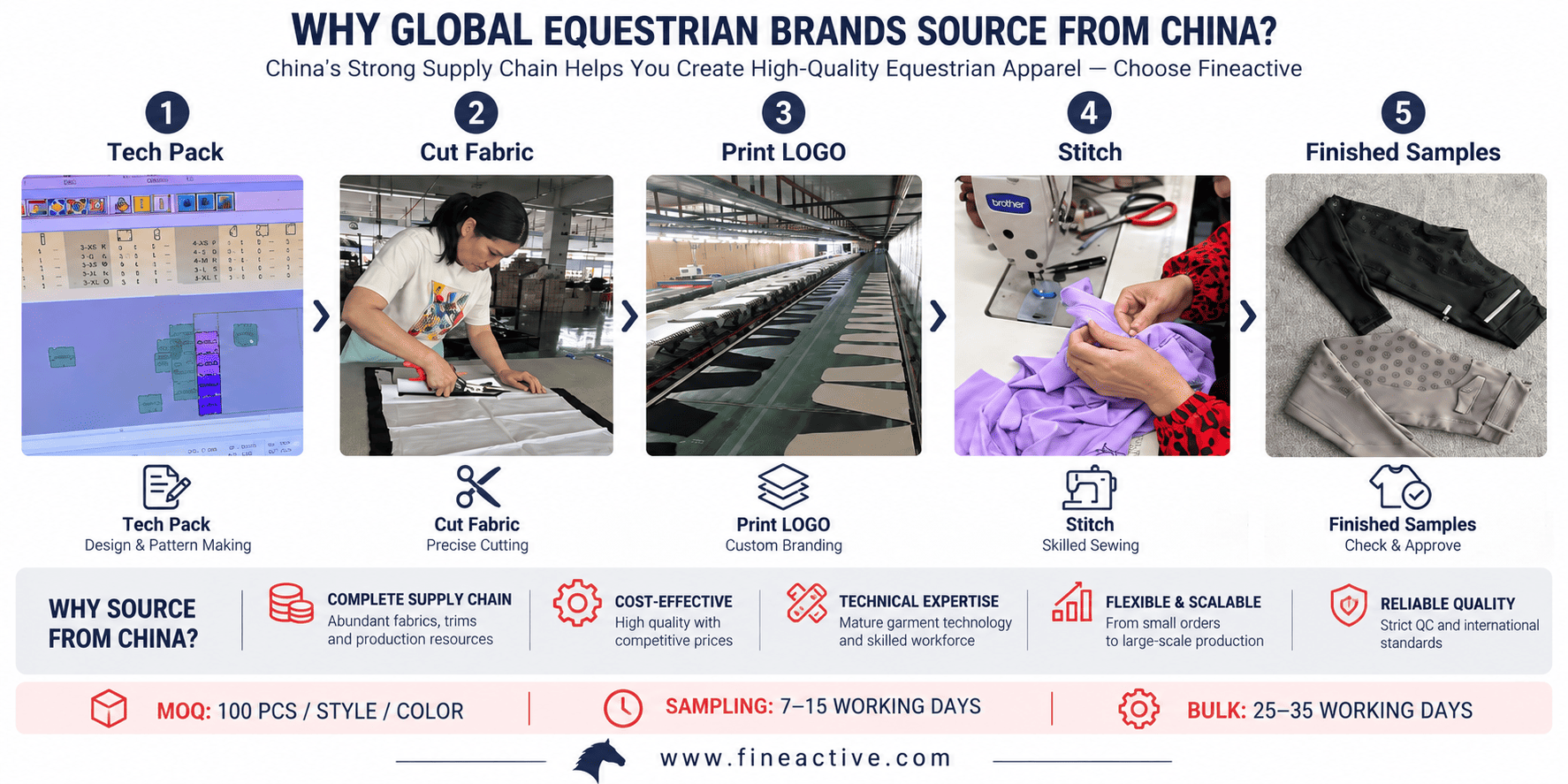
Global equestrian brands source clothing from China because the country offers an established garment manufacturing industry, extensive material sourcing networks, experienced export suppliers, and a wide choice of production partners. For buyers comparing horse riding clothing manufacturers in China, these advantages can support supplier selection across different product categories and order volumes. However, China is not automatically the cheapest or most suitable sourcing destination for every brand. The strongest purchasing decisions consider manufacturing specialization, total delivered cost, production reliability, and the requirements of the target market.
What Makes China a Competitive Sourcing Market for Equestrian Clothing?
China’s main sourcing advantage is the breadth of its garment manufacturing ecosystem.
International buyers can compare factories specializing in particular clothing categories, manufacturers producing multiple types of performance apparel, and companies coordinating wider equestrian product ranges.
This diversity allows brands to evaluate suppliers according to their business model rather than relying on a single manufacturing approach.
For example, a startup launching riding leggings may prioritize a supplier with manageable order minimums and relevant apparel experience. An established equestrian retailer may place greater value on product assortment, purchasing efficiency, and the ability to coordinate multiple categories.
Four factors make China particularly relevant to international equestrian clothing buyers.
1. Broad supplier availability
China has a substantial garment manufacturing base, allowing buyers to compare suppliers with different product specializations, order requirements, and commercial models.
This creates opportunities to shortlist manufacturers according to specific purchasing needs.
2. Established sourcing networks
Fabric mills, accessory suppliers, garment factories, packaging providers, and export service companies form interconnected supply networks.
These relationships can support efficient sourcing, although actual performance depends on the manufacturer’s management and supplier relationships.
3. Different production scales
Buyers can find suppliers serving relatively small private label programs as well as manufacturers handling larger production volumes.
The availability of different business models gives brands more options when planning launches, expansion, and replenishment.
4. International trade experience
Many Chinese apparel suppliers have experience coordinating overseas orders, export documentation, international logistics, and communication with foreign buyers.
However, buyers should still verify each company’s export capabilities and contractual responsibilities.
For equestrian clothing brands, these advantages are most valuable when they lead to reliable production, commercially sustainable orders, and consistent supply.
China vs Europe vs Other Asian Countries: Which Sourcing Market Is Better?
China is one of several manufacturing markets available to equestrian clothing brands.
European countries, Vietnam, Bangladesh, and Turkey may also offer suitable manufacturing options depending on product requirements, order size, target market, and supply chain priorities.
There is no universal winner.
The following comparison summarizes common sourcing considerations.
| Sourcing Market | Potential Advantages | Main Considerations | Potential Buyer Fit |
|---|---|---|---|
| China | Broad supplier choice, established material networks, extensive garment production resources | International freight, supplier verification, import requirements | Brands seeking multiple supplier options and coordinated sourcing |
| Europe | Regional proximity for European customers, opportunities for closer collaboration | Manufacturing costs, supplier availability, production scale | Brands prioritizing regional sourcing and shorter transport distances |
| Vietnam | Established export garment industry, opportunities for supply chain diversification | Factory specialization, material availability, minimum quantities | Brands evaluating alternative Asian production locations |
| Bangladesh | Large apparel manufacturing industry, potential cost advantages for suitable orders | Product specialization, development flexibility, order requirements | Buyers with established specifications and suitable production volumes |
| Turkey | Developed textile industry, proximity to European markets | Pricing, supplier specialization, available production capacity | European brands seeking regional supply chain options |
These comparisons describe potential market characteristics rather than guaranteed advantages for individual factories.
A European equestrian brand may prefer a nearby manufacturer because easier factory visits and regional transport are important to its operations.
A growing international brand may prefer China because it wants to compare several suppliers across riding breeches, competition clothing, and seasonal apparel.
Another business may use factories in more than one country to diversify production risk.
The right sourcing market is the one that supports the brand’s product requirements, cost structure, delivery expectations, and risk tolerance.
Specialized Equestrian Manufacturers vs General Sportswear Factories: What Is the Difference?
Not every Chinese factory advertising riding apparel has the same business focus.
Some manufacturers concentrate primarily on equestrian clothing. Others produce riding garments as part of a wider sportswear portfolio.
There are also suppliers whose catalogs include both rider apparel and horse-related products.
Understanding these differences helps buyers build a more relevant shortlist.
| Supplier Type | Typical Product Positioning | Potential Advantages | Main Evaluation Priority |
|---|---|---|---|
| Specialized equestrian apparel manufacturer | Riding breeches, competition clothing, riding tops, outerwear | Focused product experience | Evidence of riding apparel production and consistency |
| Multi-category sportswear manufacturer | Equestrian wear, yoga wear, fitness apparel, sportswear | Broader clothing development experience | Relevant equestrian-specific manufacturing capability |
| Broader equestrian product supplier | Rider clothing, saddle pads, horse rugs, accessories | Consolidated product sourcing | Clarity over garment production responsibility |
For example, Fineactive and RunEquestrian position themselves around equestrian apparel, while SGL Sports and Shuyu Activewear also serve broader sportswear markets.
Zest Equestrian and OpeEquestrian offer clothing alongside other equestrian products.
These differences do not automatically determine which supplier delivers better quality.
A multi-category sportswear factory may have excellent garment production capabilities. Likewise, a specialized equestrian manufacturer may not be suitable for every product or order size.
Buyers should evaluate actual manufacturing evidence rather than assuming that a supplier’s product focus guarantees performance.
For clothing-focused brands, relevant production experience and repeat-order consistency may carry more weight than the total number of products in a supplier’s catalog.
For retailers sourcing both rider clothing and horse products, broader product coverage may be commercially attractive.
What Are the Main Advantages and Limitations of Sourcing from China?
China can provide international buyers with considerable supplier choice and manufacturing resources, but overseas sourcing also introduces operational responsibilities.
A balanced assessment should consider both opportunities and risks.
Potential Advantages
Supplier choice
Buyers can compare multiple manufacturers instead of depending on a single local production option.
Product category coverage
China’s apparel industry includes suppliers working across different garment types, price segments, and order volumes.
Supply chain coordination
Established sourcing networks may help manufacturers coordinate materials, production, packaging, and shipment arrangements.
Growth opportunities
Brands may be able to identify suppliers that support collection expansion or larger repeat orders as their businesses develop.
Potential Limitations
Longer international logistics
Ocean freight, air freight, customs procedures, and destination delivery can add time and cost.
Supplier verification requirements
Business registration, factory ownership, production responsibilities, and advertised capabilities require careful evaluation.
Import duties and regulatory obligations
Tariffs, customs rules, product labeling, and other requirements differ by destination market and can change over time.
Communication and scheduling
Time-zone differences, language barriers, and seasonal production demand may affect coordination.
Supply chain concentration
Relying heavily on one supplier or manufacturing region can increase exposure to disruption.
These risks do not necessarily make Chinese sourcing unsuitable.
They highlight the importance of comparing suppliers using complete commercial and operational information.
How Should Buyers Compare Total Sourcing Value Across Countries?
A common mistake is comparing manufacturers solely by their quoted factory prices.
For international equestrian clothing brands, the final purchasing decision should reflect the total cost and reliability of receiving saleable garments.
A practical comparison should consider:
Factory unit price and development expenses.
International freight and cargo insurance.
Applicable import duties and customs charges.
Inspection and quality-related expenses.
Inventory holding costs and replenishment requirements.
Production and transportation lead times.
The potential financial impact of defects or delays.
For example, a manufacturer offering a lower unit price may not provide the best overall value if international shipping, additional inspections, or delayed replenishment significantly increase costs.
Conversely, a supplier with a higher initial quotation may be commercially attractive when its production consistency and delivery arrangements reduce operational uncertainty.
Brands should compare quotations using equivalent product specifications, order quantities, shipping terms, and destination markets.
The lowest manufacturing price is not necessarily the lowest total sourcing cost.
This principle applies whether the supplier is located in China, Europe, or another Asian manufacturing market.
When Is China the Right Sourcing Choice for an Equestrian Brand?
China may be particularly suitable for equestrian clothing brands that want access to multiple manufacturers, coordinated sourcing networks, and a range of production models.
However, the decision should reflect the brand’s purchasing priorities.
| Buyer Priority | What to Evaluate |
|---|---|
| Launching a new collection | MOQ flexibility, development costs, supplier specialization |
| Expanding an established range | Production capacity, product consistency, repeat-order performance |
| Sourcing premium riding apparel | Relevant manufacturing experience and verifiable quality evidence |
| Managing several product categories | Supplier range, production accountability, purchasing coordination |
| Reducing supply chain risk | Factory transparency, backup suppliers, regional diversification |
| Serving a specific geographic market | Delivered cost, import requirements, transport time |
For some businesses, China will be the most practical sourcing market. For others, regional manufacturing or a combination of suppliers across different countries may offer a better balance.
The objective is not to choose China simply because it is a major garment manufacturing country.
It is to identify whether the available Chinese equestrian clothing manufacturers can meet the brand’s purchasing requirements more effectively than the alternatives.
A well-informed decision begins with comparing relevant suppliers, verifying their capabilities, and evaluating the complete commercial picture.
3. How Can Buyers Compare and Verify Chinese Equestrian Clothing Manufacturers?
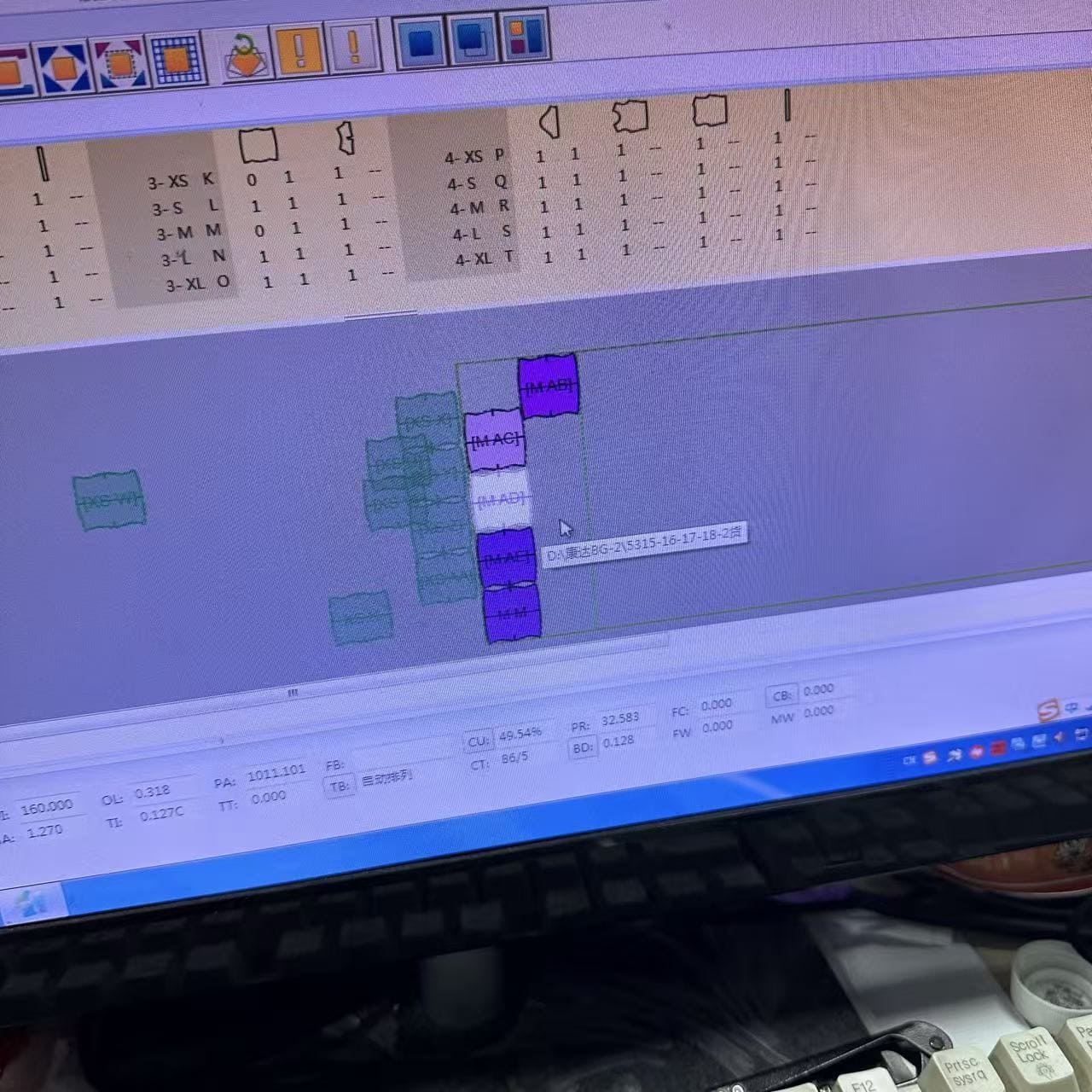
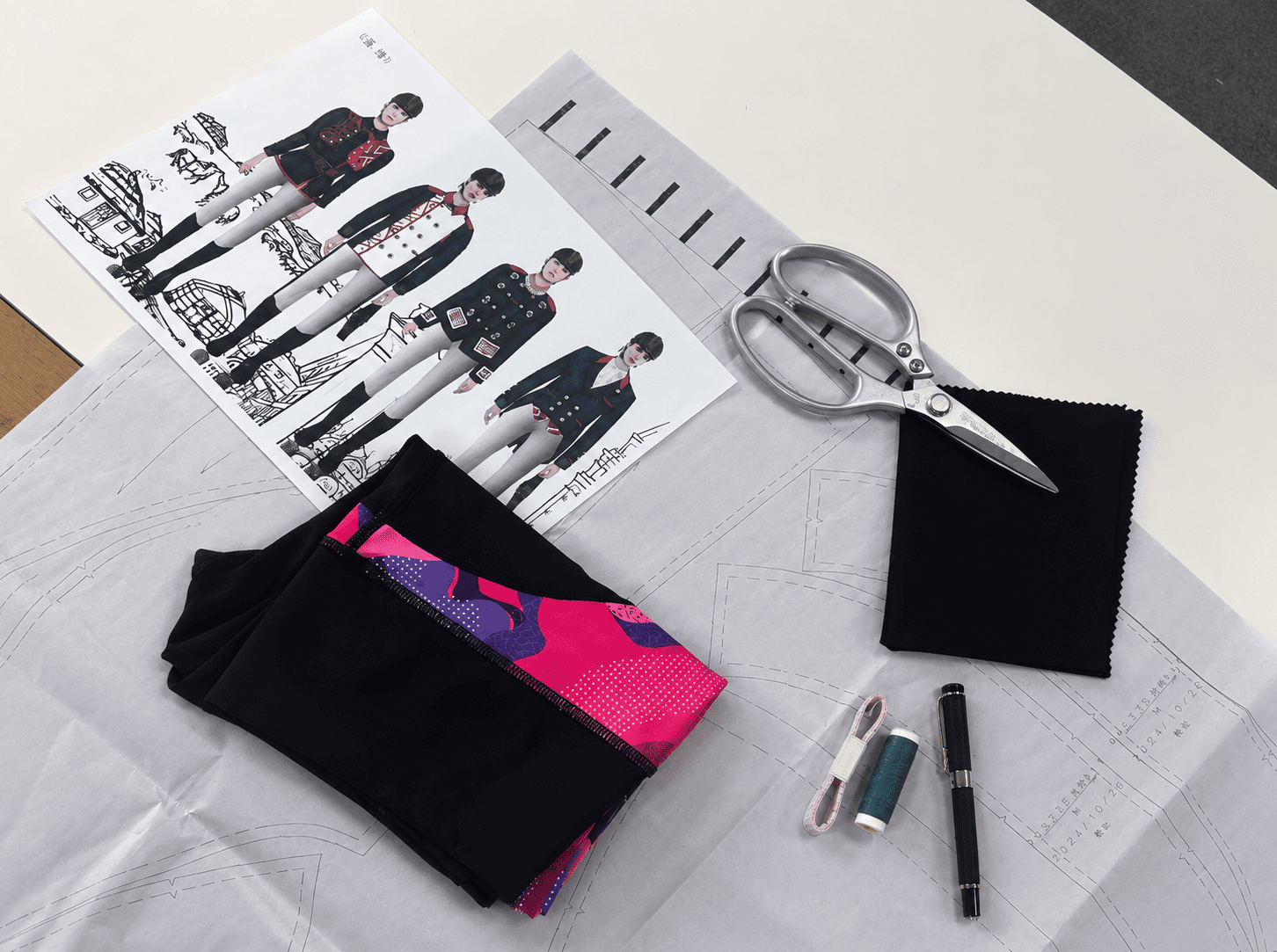
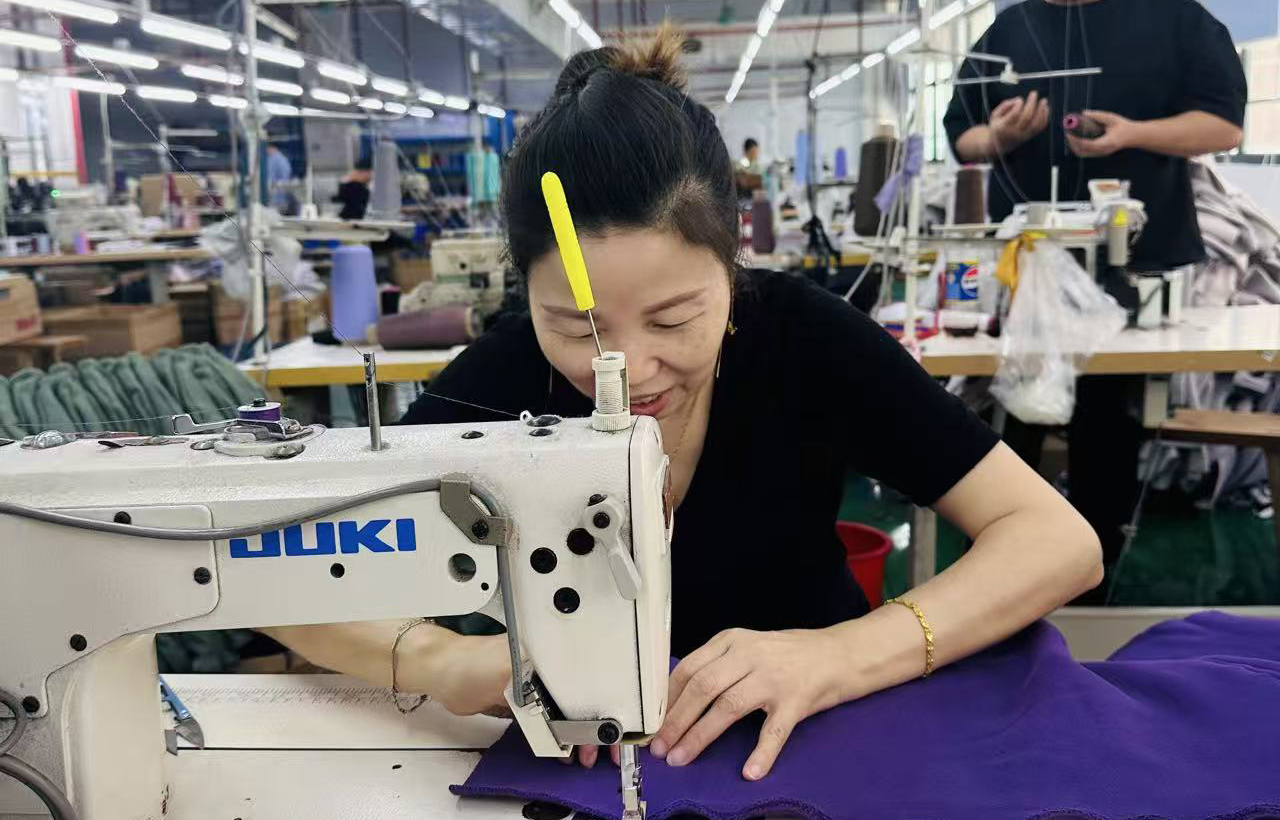
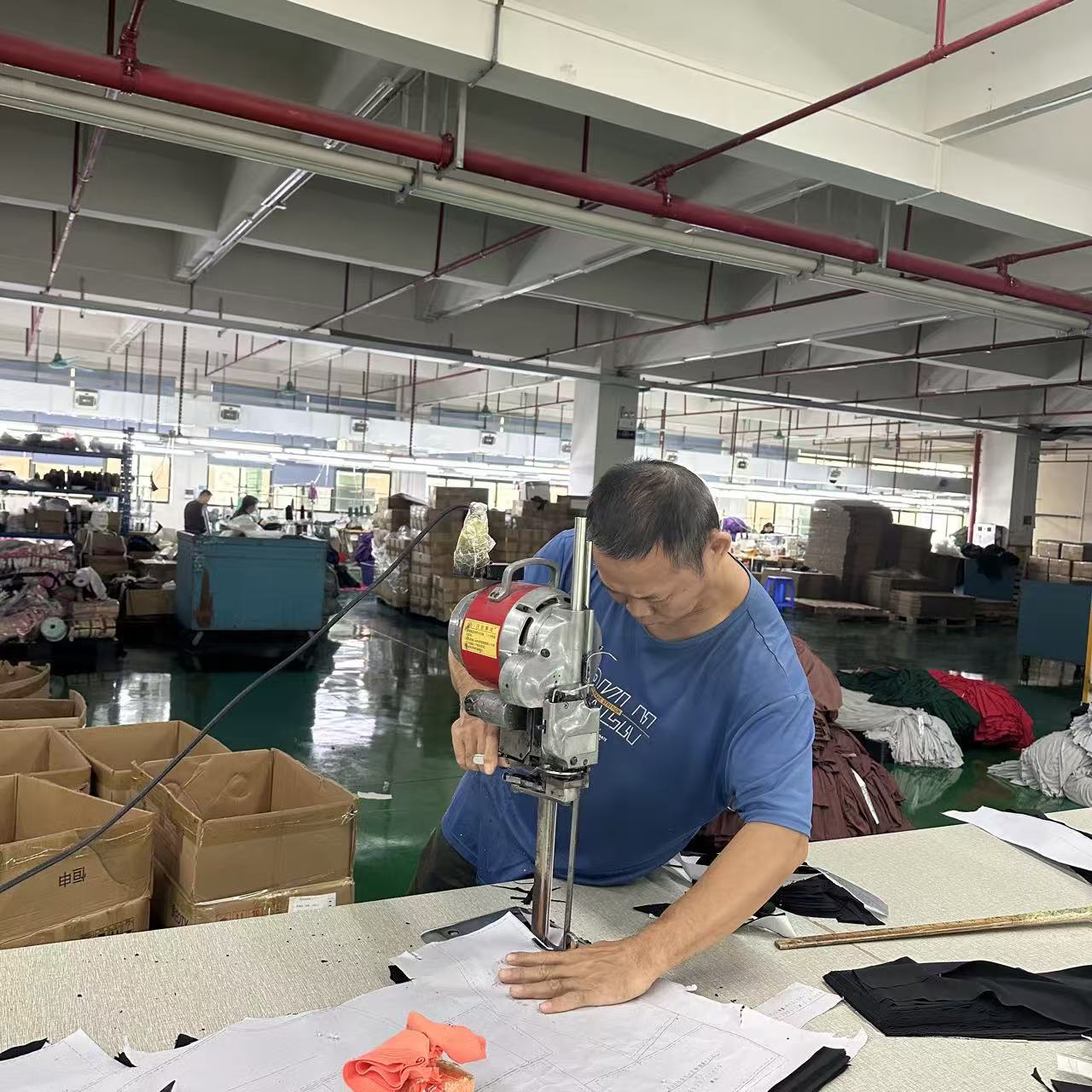
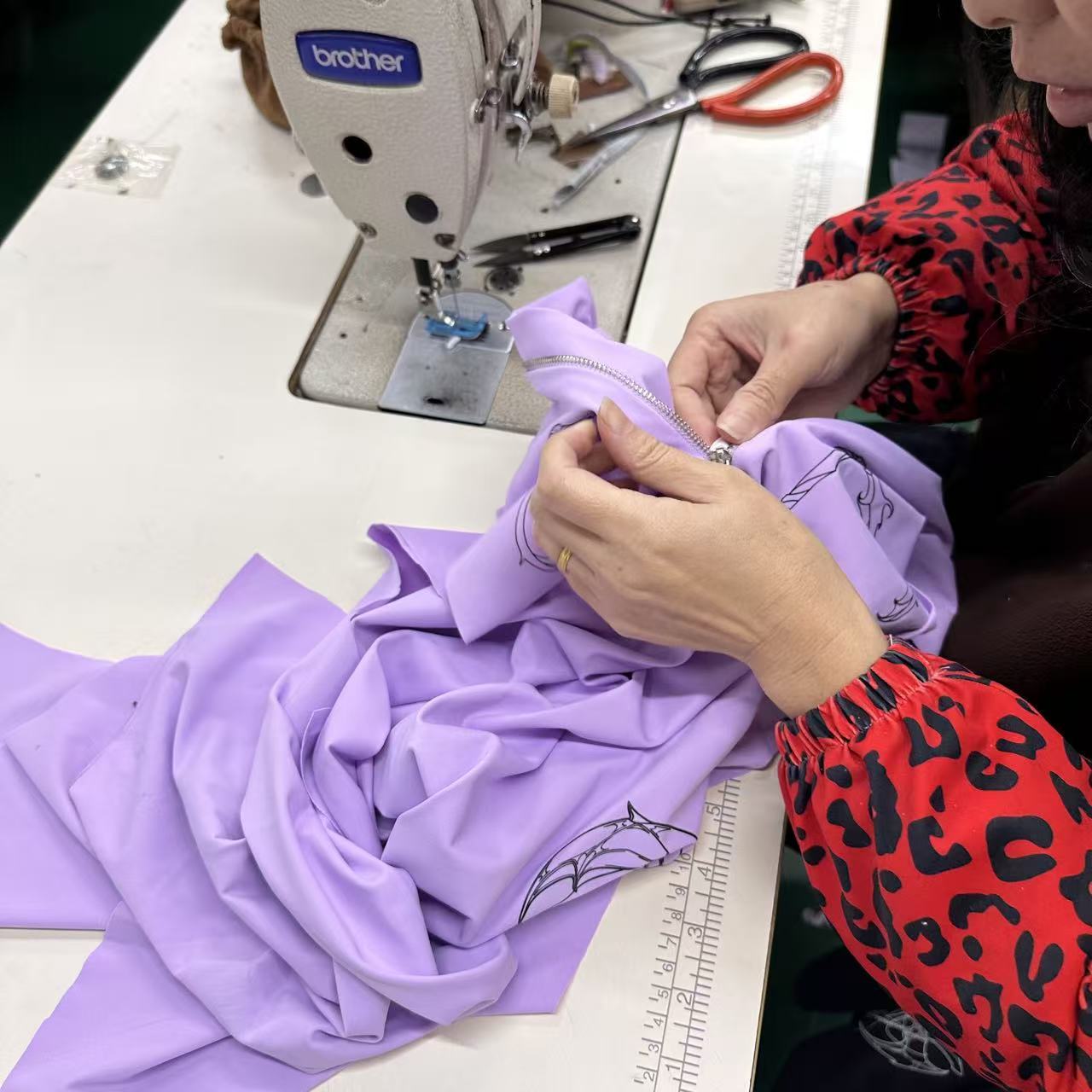
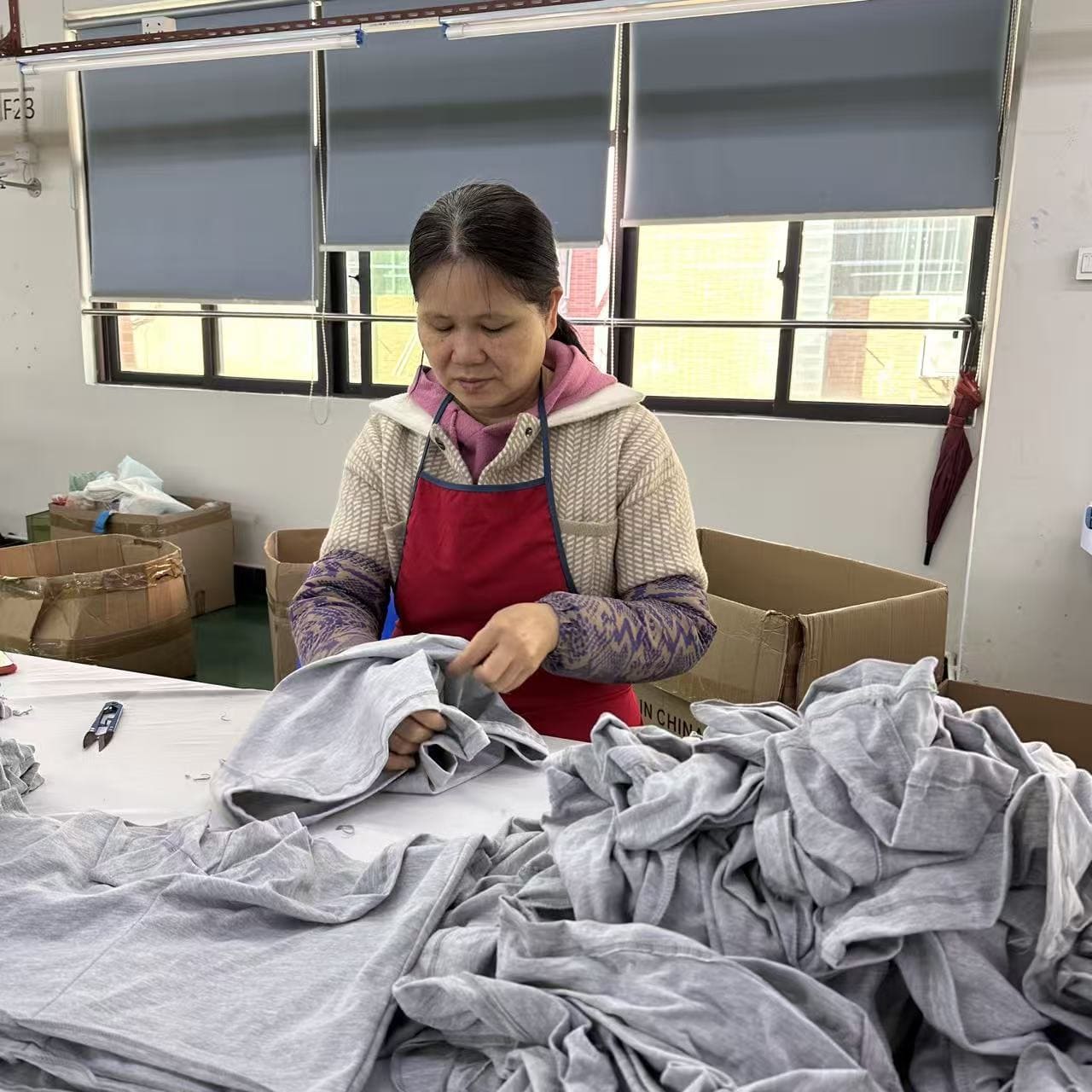
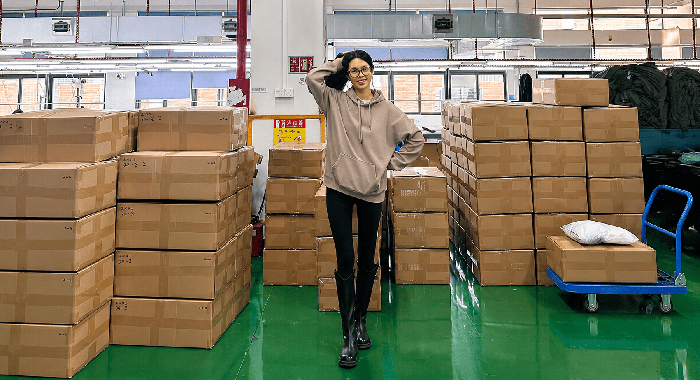
Buyers should compare Chinese equestrian clothing manufacturers using five measurable criteria: product specialization, verified manufacturing capability, commercial suitability, delivery reliability, and business transparency. Factory websites and supplier directories provide useful starting points, but they do not independently establish production quality or reliability. A sound evaluation combines company registration checks, comparable product evidence, relevant certificates, consistent quotations, and direct communication. Applying the same criteria to every shortlisted supplier helps brands make decisions based on verifiable information rather than marketing claims.
What Criteria Should Buyers Use to Compare Equestrian Clothing Suppliers?
A structured comparison makes it easier to identify which manufacturers deserve closer attention.
Without a consistent evaluation method, buyers may favor the supplier offering the lowest price, the largest product catalog, or the most attractive website. These factors can be useful, but none establishes whether a manufacturer is suitable for a particular order.
A practical approach is to assign each supplier a score out of 100.
Chinese Equestrian Clothing Manufacturer Evaluation Scorecard
| Evaluation Category | Weight | What Buyers Should Compare |
|---|---|---|
| Product Specialization | 25 points | Experience with the intended riding apparel category, comparable products, customer segments |
| Manufacturing & Quality Evidence | 25 points | Factory identity, relevant production records, inspection evidence, applicable documentation |
| Commercial Suitability | 20 points | MOQ, complete quotation, payment terms, repeat-order conditions |
| Delivery Reliability | 15 points | Production scheduling, material availability, capacity commitments, shipment history |
| Communication & Business Transparency | 15 points | Response quality, legal identity, subcontracting disclosure, document consistency |
| Total | 100 points | Overall supplier suitability |
This weighting places the greatest emphasis on relevant manufacturing experience and supporting evidence.
For example, a company specializing in riding breeches may deserve a stronger product-specialization score when the buyer is sourcing breeches. The same supplier may receive a lower score for a garment category outside its established range.
Commercial suitability should also reflect the buyer’s business model.
A 200-piece minimum may be reasonable for an established brand but unsuitable for a startup testing several colors.
The scorecard should be completed using evidence gathered from each supplier, not assumptions based on company size or advertised experience.
How Can Buyers Verify a Chinese Manufacturer’s Legal Identity and Business History?
Verifying the legal identity of a supplier is an important first step in international sourcing.
A professional website, trade show booth, or supplier marketplace profile does not automatically prove that the company is legally registered or operates the production facility it advertises.
Buyers should establish the identity of the business responsible for the order.
Start by requesting the supplier’s full registered Chinese company name, business registration information, operating address, and payment beneficiary details.
The National Enterprise Credit Information Publicity System provides official Chinese business registration information that can help buyers investigate company identity and registration status.
What Business Information Should Be Checked?
| Information | Why It Matters |
|---|---|
| Registered company name | Identifies the legal business entering the transaction |
| Registration status | Helps establish whether the company is currently registered |
| Establishment date | Provides context for claims about business history |
| Registered address | Helps identify the company’s registered location |
| Business scope | Indicates the activities listed in the company’s registration |
| Payment beneficiary | Helps confirm whether payments are directed to the agreed business entity |
| Production facility address | Identifies where the garments are expected to be manufactured |
A company’s registration date and its claimed manufacturing experience may differ for legitimate reasons.
For example, a business may have operated through a predecessor company before establishing its current legal entity.
However, buyers should distinguish between a verified incorporation date and a supplier’s advertised years of industry experience.
Business registration confirms aspects of a company’s legal identity; it does not prove factory ownership, production capacity, or garment quality.
Those capabilities require additional verification.
Manufacturer vs Trading Company: How Can You Tell the Difference?
Chinese equestrian clothing suppliers may operate as direct manufacturers, trading companies, or businesses combining manufacturing with outsourced production.
Each model has potential advantages.
A direct manufacturer may offer closer communication with production teams and greater visibility into manufacturing operations.
A trading company may provide access to several factories and help coordinate different product categories.
A hybrid supplier may manufacture some garments internally while outsourcing specialized products or processes.
The important question is not simply whether a company describes itself as a factory.
Buyers need to know who manufactures their garments and who is accountable for the finished order.
Comparing Supplier Business Models
| Supplier Model | Potential Advantages | Questions to Ask |
|---|---|---|
| Direct manufacturer | Closer production coordination, direct factory communication | Which processes are performed at the stated facility? |
| Trading company | Access to multiple factories and broader product sourcing | Which factory will produce the garments, and who manages quality? |
| Manufacturer with subcontractors | Access to specialized production processes | Which operations are outsourced, and how are they controlled? |
| Sourcing company with production partners | Flexible factory selection and purchasing coordination | Who is responsible for production approval, defects, and delivery? |
Buyers can request a live factory walkthrough, a third-party site assessment, or relevant production documentation.
During a walkthrough, ask to see the facility responsible for the proposed garment category rather than relying exclusively on a showroom or finished product display.
For example, a supplier offering riding breeches should be able to explain where garment construction takes place and how the finished order is inspected.
If another facility performs part of the production, the arrangement should be transparent.
A trading company is not automatically less reliable than a direct factory. Likewise, owning a factory does not guarantee consistent performance.
Clear responsibility, traceable production arrangements, and dependable communication are more important than the supplier’s business label alone.
Which Factory Certifications and Audit Documents Should Buyers Verify?
Certifications and audits can provide useful information about a supplier’s management systems, workplace practices, materials, or product compliance.
However, buyers should understand what each document actually covers.
A certificate displayed on a website may apply to a different legal entity, production facility, material, or product category.
The document’s relevance is therefore more important than the number of certification logos displayed.
Common Documents Used in Apparel Supplier Verification
| Document | What It May Demonstrate | What Buyers Should Confirm |
|---|---|---|
| ISO 9001 Certificate | Certification of a quality management system | Validity, certified entity, issuing body, and scope |
| amfori BSCI Audit | Assessment of social compliance conditions at a production site | Facility identity, audit date, findings, and corrective actions |
| GRS Certification | Certification related to recycled materials and chain-of-custody requirements | Certified organization, product scope, and relevant material documentation |
| OEKO-TEX STANDARD 100 | Testing of covered textile articles for specified harmful substances | Certificate validity and the specific products or materials covered |
| Factory Audit Report | Observations about a particular manufacturing facility | Auditor, inspection date, site, findings, and limitations |
| Product Test Report | Results of specified tests on an identified product or material | Tested item, method, date, results, and relevance |
| Inspection Report | Findings from a defined inspection of goods | Order identity, sampling method, defects, and inspection outcome |
When reviewing textile safety claims, buyers can refer to the official OEKO-TEX STANDARD 100 information to understand the scope of harmful-substance testing and assess whether a supplier’s certificate covers the relevant materials or products.
Different documents answer different questions.
For example, ISO 9001 certification concerns a quality management system. It does not independently guarantee that every shipment will meet the buyer’s garment specifications.
Similarly, a fabric certificate does not automatically establish that the entire finished garment carries the same certification.
Buyers should also distinguish between a factory audit and a product test.
A factory audit may provide information about operating conditions, while a product test evaluates particular characteristics under specified conditions.
A credible supplier should be able to explain which documents apply to the facility, materials, and garments involved in the proposed order.
How Can Buyers Confirm That a Factory’s Published Capabilities Are Genuine?
Manufacturers often advertise production lines, monthly capacity, employee numbers, and experience with international brands.
These figures may be useful when evaluating a supplier, but they require context.
A factory producing several types of clothing may report its total garment output rather than the capacity available for equestrian apparel.
Likewise, a large workforce does not necessarily mean the factory has extensive experience with every product category in its catalog.
Buyers should focus on whether the supplier has sufficient relevant capability for the proposed order.
Four forms of evidence are particularly useful.
1. Comparable product examples
Ask to review garments similar to the intended collection.
A manufacturer producing riding breeches should be able to demonstrate relevant examples rather than relying entirely on general leggings or fitness clothing.
2. Production facility information
Confirm which facility will manufacture the order and whether the relevant equipment and workforce are available.
3. Capacity and scheduling evidence
Ask how the proposed order fits into the factory’s existing production schedule.
A quoted capacity figure is less useful if most of that capacity is already committed.
4. Consistent commercial information
Compare the supplier’s website claims with its quotation, product specifications, and responses during technical discussions.
Major inconsistencies may indicate that additional verification is necessary.
Buyers should also consider how recently the evidence was produced.
A factory photograph from several years ago may not reflect current operating conditions.
Current, order-relevant evidence is more useful than impressive but outdated company statistics.
What Are the Most Common Warning Signs When Comparing Chinese Suppliers?
Some supplier risks become visible before samples are ordered or deposits are paid.
Recognizing these warning signs can help buyers avoid unnecessary financial exposure.
| Warning Sign | Potential Risk | Recommended Buyer Response |
|---|---|---|
| Company names differ across documents | Unclear legal or payment responsibility | Confirm the correct contracting entity |
| Factory location cannot be verified | Uncertain production arrangements | Request facility information or an independent assessment |
| Certificates are expired or unrelated | Unsupported compliance claims | Verify the issuing body, scope, and validity |
| Quotation omits major cost items | Unexpected expenses | Request a complete written quotation |
| Production promises are unusually aggressive | Delivery risk | Ask for a milestone-based schedule |
| Supplier avoids discussing subcontractors | Limited production transparency | Clarify who performs and controls critical operations |
| Product information changes repeatedly | Weak specification management | Confirm requirements in writing |
| Inspection access is refused without explanation | Limited quality visibility | Resolve inspection terms before ordering |
One warning sign does not always justify rejecting a supplier.
For example, a company may use an English trading name that differs from its registered Chinese name. This can be legitimate when the relationship is properly documented.
However, unresolved contradictions involving legal identity, payment information, production responsibility, or quality evidence deserve particular attention.
Buyers should also be cautious about claims such as “100% defect-free production” or guaranteed delivery dates before material availability and order specifications have been confirmed.
Manufacturing involves operational variables, and responsible suppliers should explain how they manage them.
How Should Buyers Use Verification Results to Build a Supplier Shortlist?
Verification should help buyers reduce uncertainty and select manufacturers that match their requirements.
It should not become an exercise in collecting certificates without understanding their relevance.
A practical shortlist can be developed in three stages.
First, confirm basic eligibility.
Remove suppliers whose product focus, MOQ, business identity, or commercial model clearly does not match the purchasing requirement.
Second, compare relevant evidence.
Review comparable garments, facility information, applicable documents, quotations, and delivery commitments using the same criteria for each supplier.
Third, identify unresolved risks.
Determine whether any missing information is a minor documentation issue or a significant concern affecting production, payment, quality, or delivery.
A supplier with a slightly higher quotation may be preferable if it provides clearer production accountability and stronger evidence of relevant manufacturing experience.
Conversely, a company with a large catalog and attractive prices may be a weaker candidate if its actual production arrangements remain unclear.
The objective is to narrow the supplier list to manufacturers that merit further commercial and product evaluation.
For international equestrian brands, effective supplier verification means confirming that a company is legitimate, its relevant manufacturing claims are credible, and its commercial arrangements are sufficiently transparent to support a reliable purchasing relationship.
4. How Do MOQ, Factory Prices and Lead Times Compare Across Suppliers?
Minimum order quantities, factory prices, and production lead times vary considerably among Chinese horse riding clothing manufacturers. Some suppliers advertise minimums starting at 100 pieces for specified garments, while others require 200 pieces or set quantities according to fabric, color, and product complexity. Factory quotations are rarely directly comparable without matching specifications and trade terms. For international equestrian brands, the most useful comparison considers minimum order requirements, complete landed costs, sampling commitments, and realistic production schedules rather than the lowest advertised unit price.
What Are the Minimum Order Quantities of the Top 10 Chinese Equestrian Clothing Suppliers?
MOQ is one of the first commercial requirements buyers should evaluate when shortlisting manufacturers.
However, a published minimum quantity does not necessarily apply to every garment, fabric, color, or customization option.
Some factories calculate MOQ per style, while others apply minimums separately to each color or fabric.
For example, an order of 100 pieces per style per color may require 300 garments when the same riding breeches design is produced in three colors.
The following table summarizes the MOQ information available for the ten suppliers discussed in this guide.
| Manufacturer | Published or Reported MOQ | What Buyers Should Confirm |
|---|---|---|
| Fineactive | 100 pieces per style per color | Size mixing and requirements for different styles |
| SGL Sports | 200 pieces per design per color on selected products | Whether the minimum applies to the requested garment |
| Zest Equestrian | From 200 pieces on published equestrian clothing offers | Product-specific quantities and customization conditions |
| Equifactory | Flexible; product-dependent | Minimums for each garment and fabric option |
| Kala Active | Product-dependent | Style, color, and material requirements |
| RunEquestrian | From 100 pieces per style on published offers | Minimums for different colors and designs |
| Shuyu Activewear | Product-dependent | Fabric minimums and style combinations |
| RW Equestrian | From 100 pieces on selected listings | Seasonal product and color requirements |
| Hubei KDL | Not consistently published | Current minimums for the proposed product |
| OpeEquestrian | Product-dependent | Apparel-specific MOQ and customization conditions |
Published minimums are indicative and should be reconfirmed through current written quotations. Product-dependent or unpublished minimums should not be interpreted as low MOQ offers.
Why Can MOQ Differ Between Two Similar Garments?
Two factories may quote different minimums for similar riding breeches because their purchasing arrangements and production schedules differ.
MOQ can be affected by:
Fabric availability and minimum purchasing quantities.
Whether a color is stocked or requires custom production.
The number of sizes and color variations.
Garment construction and production setup requirements.
Branding, labeling, and packaging specifications.
The factory’s current production schedule.
For a startup, a lower MOQ may reduce initial inventory exposure.
For an established brand, a higher MOQ may be acceptable if it supports a more competitive unit price or stable replenishment.
The right MOQ is the quantity that matches expected demand, available capital, and the brand’s inventory strategy.
How Much Does It Cost to Manufacture Horse Riding Clothing in China?
There is no single reliable factory price for custom horse riding clothing in China.
Prices depend on the garment specification, order quantity, materials, construction requirements, branding, and purchasing terms.
A riding breeches quotation should not be compared directly with another supplier’s quotation unless both are based on equivalent requirements.
Even when two suppliers quote the same garment category, their prices may include different services or materials.
What Should Be Included in a Comparable Factory Quotation?
| Cost Component | Questions Buyers Should Ask |
|---|---|
| Garment unit price | What exact specifications and quantity does the price cover? |
| Development charges | Are sampling, patterns, or setup costs charged separately? |
| Materials | Are all specified fabrics, trims, and components included? |
| Branding | Are labels, logos, and packaging included in the unit price? |
| Testing | Are any required tests included or quoted separately? |
| Inspection | Who pays for independent inspection if required? |
| Trade terms | Is the quotation EXW, FOB, or based on another agreed Incoterm? |
| Payment conditions | What deposit and balance payment terms apply? |
For accurate comparisons, buyers should request quotations in the same currency and with clearly defined trade terms.
A lower unit price may become less attractive when additional charges are included.
Similarly, a higher unit price may offer better overall value if it covers items that another supplier excludes.
Factory prices should be compared using complete quotations—not isolated figures from catalogs or sales messages.
Why Is Landed Cost More Important Than Factory Unit Price?
Landed cost represents the total expense of bringing products to the agreed destination, including relevant purchasing, transport, and import-related costs.
For international equestrian clothing brands, landed cost is often a more meaningful purchasing measure than factory price alone.
Consider the following hypothetical comparison for an order of 500 riding breeches.
Example: Comparing Two Supplier Quotations
| Cost Item | Supplier A | Supplier B |
|---|---|---|
| Factory unit price | $18.00 | $20.00 |
| Garment quantity | 500 | 500 |
| Garment production cost | $9,000 | $10,000 |
| Development and setup | $500 | $200 |
| Freight and insurance | $1,100 | $900 |
| Illustrative import charges | $750 | $500 |
| Inspection and other charges | $500 | $300 |
| Total estimated landed cost | $11,850 | $11,900 |
| Estimated landed cost per garment | $23.70 | $23.80 |
This example is hypothetical. It does not represent quotations from the manufacturers listed in this guide. Actual import duties, taxes, transport expenses, and other charges depend on the product, shipment, destination, and applicable regulations.
Supplier A offers a factory price that is $2 lower per garment.
However, once the other assumed costs are included, its total advantage is only $50 across the entire order.
This illustrates why international buyers should calculate the full purchasing cost before selecting a manufacturer.
It also shows why the cheapest quotation does not necessarily create a meaningful commercial advantage.
How Do Sampling and Bulk Production Lead Times Compare?
Sampling and bulk production are separate stages, and buyers should confirm the timeline for each.
A supplier may offer a relatively short sample development period but require more time for material purchasing and bulk production.
Conversely, an established product with available materials may move through production more quickly than a completely new design.
The following table summarizes the published or previously identified timing information for selected suppliers.
| Manufacturer | Sampling Information | Bulk Production Information |
|---|---|---|
| Fineactive | 7–15 working days | 25–35 working days |
| SGL Sports | Approximately 10 working days | Approximately 35–40 days |
| Zest Equestrian | Confirm by product | Confirm by order |
| Equifactory | Confirm by product | Confirm by order |
| Kala Active | Confirm by product | Confirm by order |
| RunEquestrian | Confirm by product | Confirm by order |
| Shuyu Activewear | Confirm by product | Confirm by order |
| RW Equestrian | Product-dependent | Approximately one month off-season; potentially one to three months in peak season |
| Hubei KDL | Not consistently published | Not consistently published |
| OpeEquestrian | Confirm by product | Confirm by order |
These figures are indicative, not independently verified delivery guarantees. Suppliers may calculate lead times from different starting points, and actual schedules depend on order specifications and capacity.
What Can Cause Production Delays?
Common causes of delays include unavailable materials, late technical approvals, changes in order quantities, peak-season factory demand, and additional inspection or correction requirements.
Shipping time must also be considered separately from manufacturing time.
A factory’s production completion date does not necessarily equal the date when the garments arrive at the buyer’s warehouse.
For more reliable planning, buyers should request a written schedule identifying key milestones and the assumptions behind the quoted timeline.
What Hidden Costs Should Equestrian Clothing Buyers Watch For?
Unexpected costs can reduce margins even when the original factory quotation appears competitive.
Some expenses arise during product development, while others occur during production, shipping, or import clearance.
| Potential Extra Cost | Why It Matters |
|---|---|
| Additional sample rounds | Design revisions may increase development expenses |
| Custom material minimums | Fabric purchases may exceed the finished garment order |
| Color matching or setup fees | Certain custom specifications may require additional charges |
| Testing and inspections | Independent verification may not be included in the quotation |
| Packaging upgrades | Branded boxes, labels, and special packing may increase costs |
| Banking and currency charges | International payments can involve additional fees |
| Freight fluctuations | Shipping costs may change before dispatch |
| Import duties and taxes | Charges depend on destination rules and product classification |
| Defects and replacement shipments | Quality problems can create additional expenses and delays |
Buyers should ask each supplier to identify which costs are included, excluded, or subject to later confirmation.
A transparent quotation makes budgeting easier and reduces the risk of disputes.
How Can Buyers Compare Supplier Prices Without Sacrificing Quality?
A fair price comparison begins with identical product specifications.
When manufacturers quote different fabrics, garment constructions, or packaging requirements, the resulting prices may not represent equivalent products.
A practical comparison should follow four principles.
Compare the same product. Provide equivalent specifications, quantities, and packaging requirements to every shortlisted supplier.
Compare the same trade terms. Do not compare an EXW quotation with an FOB quotation as if both include identical responsibilities.
Compare the total cost. Include development charges, freight, applicable import costs, inspections, and other relevant expenses.
Compare the commercial risk. Consider the financial consequences of defects, delays, inconsistent repeat orders, or unclear responsibilities.
For example, a supplier offering a slightly higher price may provide a more dependable commercial arrangement if its quotation is complete and its delivery commitments are realistic.
A lower-priced supplier may still be the better choice when it demonstrates equivalent capabilities and acceptable risk.
The goal is not to avoid low prices. It is to determine whether the price represents genuine value for the required product.
Which MOQ and Lead-Time Strategy Works Best for Different Buyers?
Different equestrian businesses require different purchasing strategies.
A startup may want to limit inventory exposure, while an established brand may prioritize replenishment and predictable production capacity.
| Buyer Type | MOQ Priority | Lead-Time Priority | Recommended Comparison Focus |
|---|---|---|---|
| Startup equestrian brand | Manageable initial quantities | Sufficient time for product approval | Total launch investment |
| Growing DTC brand | Flexible repeat orders | Reliable replenishment | Inventory continuity and unit economics |
| Premium apparel label | Suitable quantities for selected products | Time for required quality checks | Product consistency and total sourcing value |
| Riding club or team | Quantities matched to membership | Delivery before events or seasons | Size distribution and confirmed delivery dates |
| Established retailer | Volume-based purchasing efficiency | Predictable seasonal deliveries | Capacity, total cost, and repeat-order reliability |
For brands comparing the top horse riding clothing manufacturers in China, commercial suitability should be assessed alongside product specialization and verified manufacturing capability.
A supplier offering the lowest MOQ may not provide the best overall value. Likewise, the shortest advertised production time may not be the most reliable.
The strongest purchasing decision balances order quantity, complete cost, delivery confidence, and the needs of the business.
5. What Evidence Proves an Equestrian Clothing Factory Can Deliver Consistent Quality?
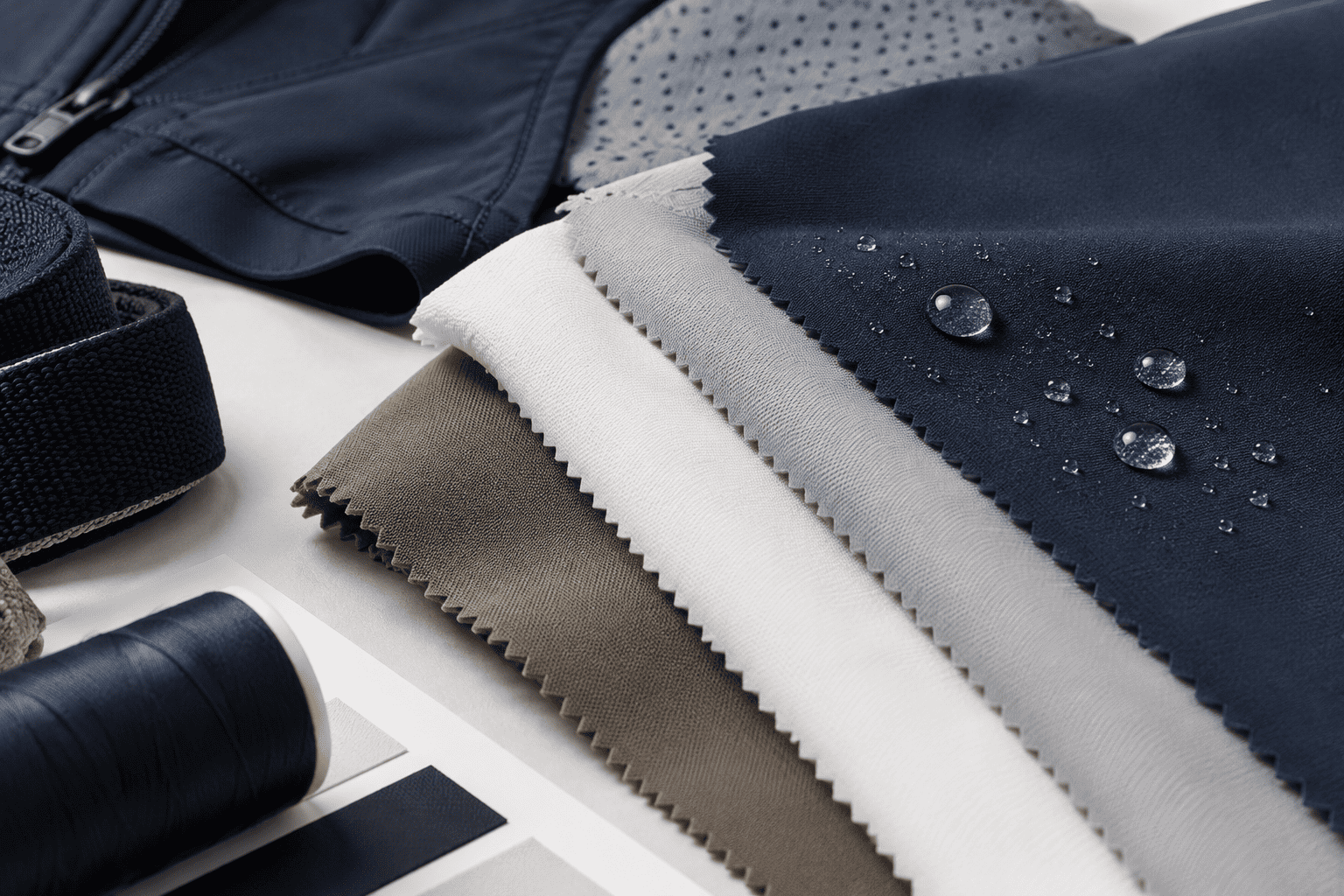
Raw material inspection based on approved quality standards
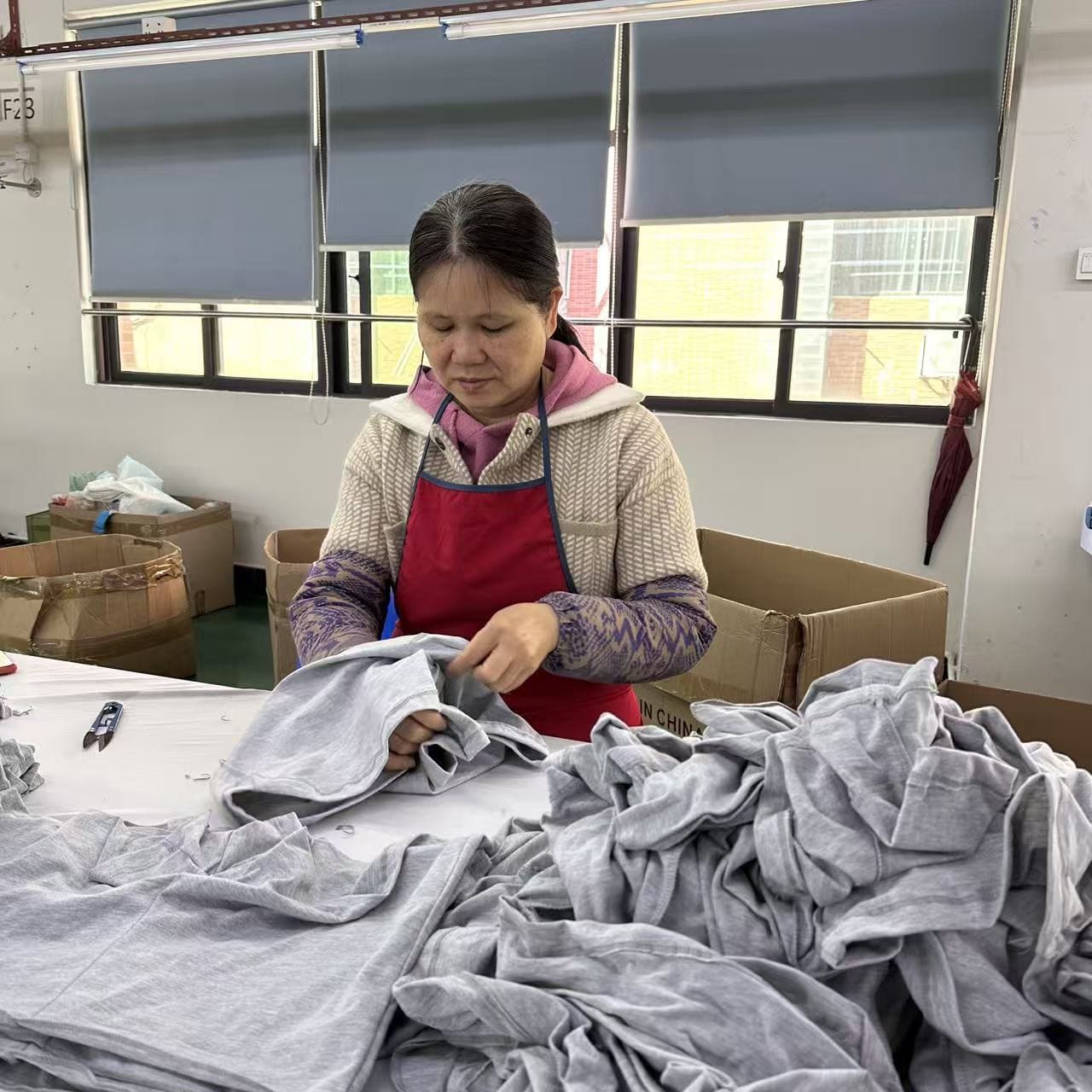
Inline sample checks during cutting, sewing, and assembly
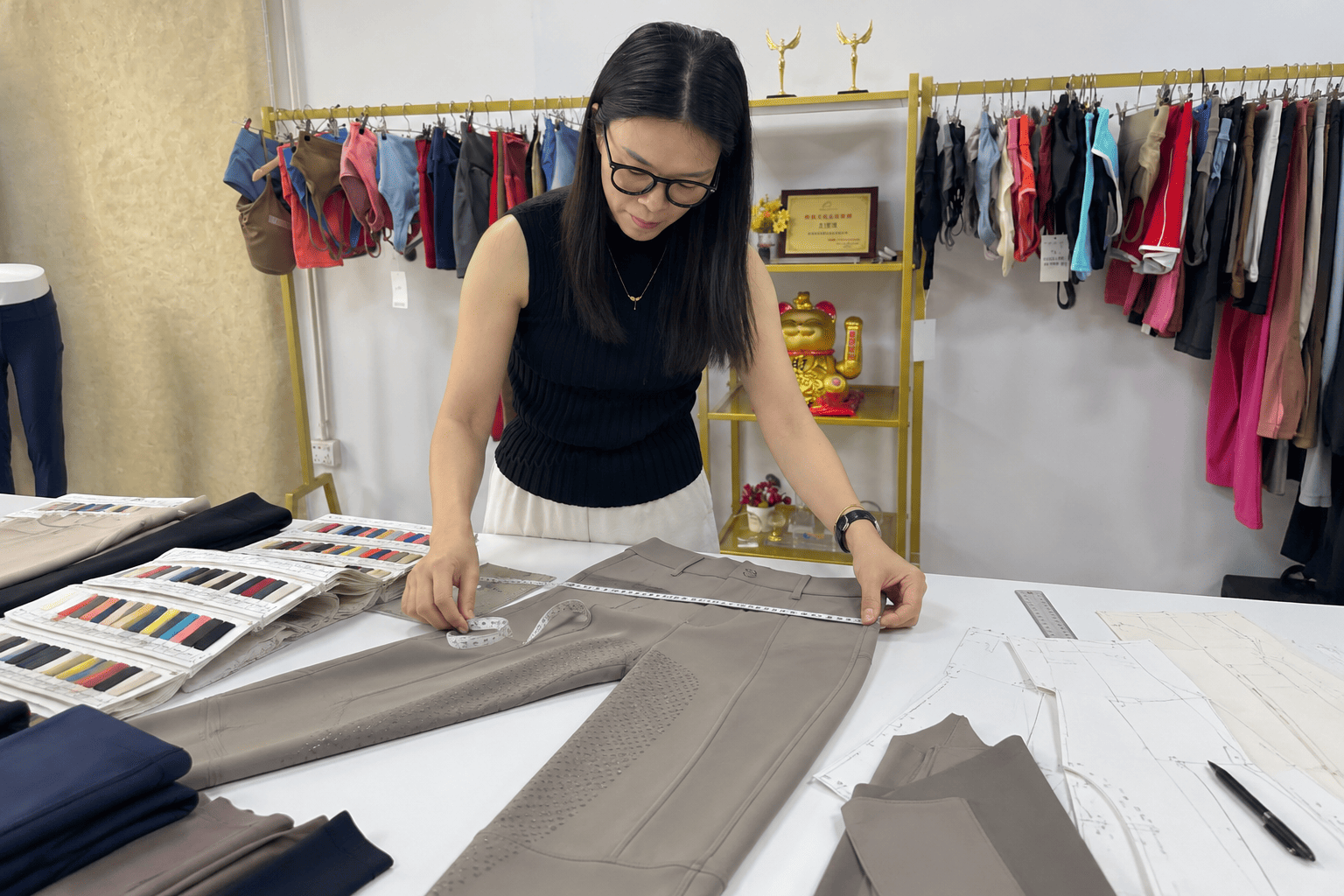
Measurements, appearance, stitching, seams, product performance
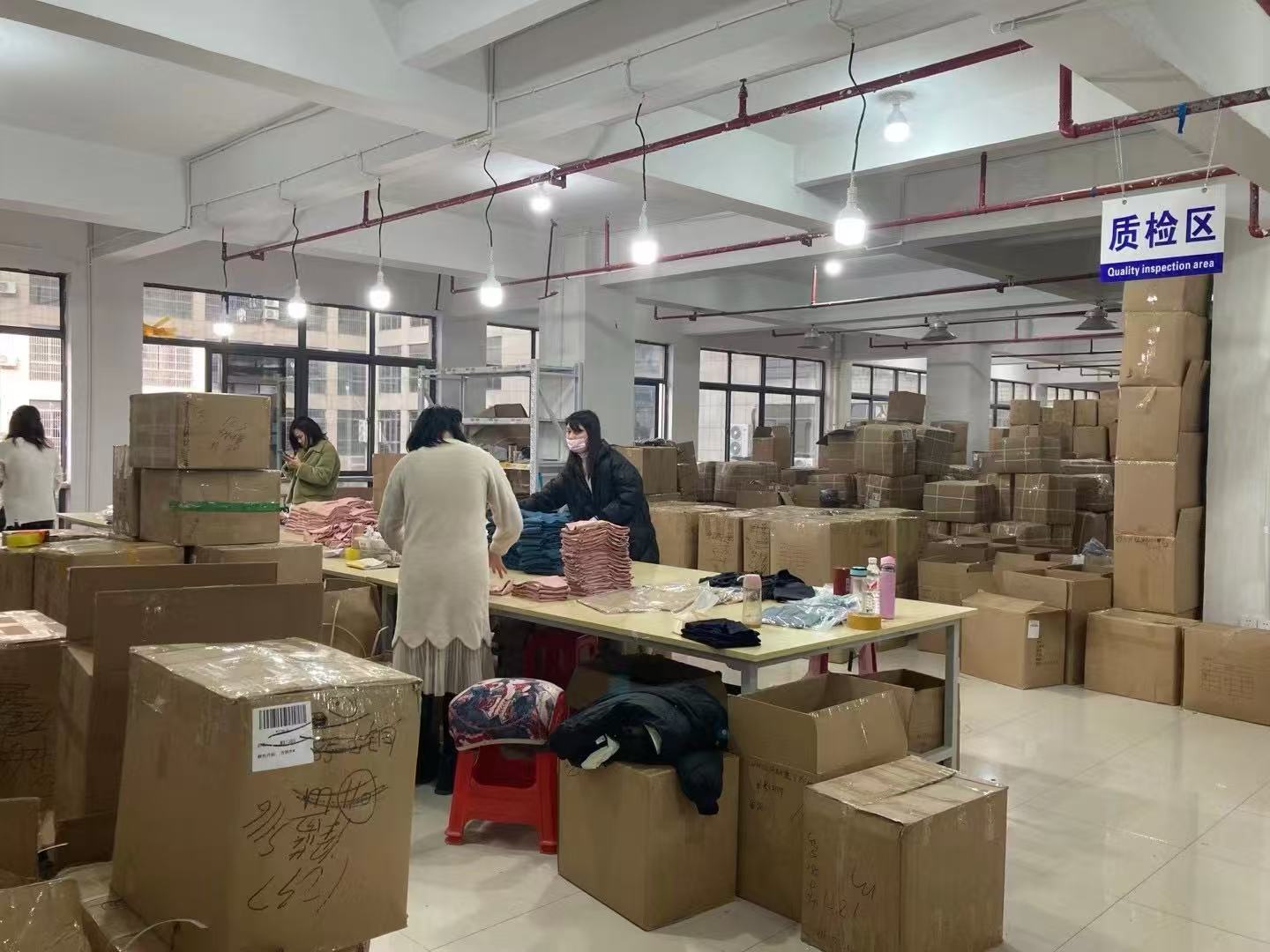
Approved AQL sampling, carton size, label, packaging
Loaded products against approved order
A reliable equestrian clothing manufacturer should demonstrate consistent quality through approved production samples, documented garment specifications, relevant test reports, inspection records, and evidence of corrective actions. Attractive product photographs and general quality promises are not sufficient. When comparing horse riding clothing manufacturers in China, buyers should examine whether each supplier can reproduce the same fit, materials, construction, and appearance across bulk orders. The strongest evidence connects a specific garment, production batch, or factory process to measurable requirements and documented results.
What Quality Evidence Should Buyers Request from Chinese Equestrian Clothing Manufacturers?
Quality claims become more meaningful when manufacturers can support them with records relevant to the proposed order.
For example, a supplier may advertise premium riding breeches, but buyers still need to understand whether the factory can maintain consistent sizing, material performance, and workmanship across hundreds or thousands of garments.
The most useful evidence is specific, current, and traceable.
Essential Quality Evidence Comparison Table
| Quality Evidence | What It Helps Verify | What Buyers Should Check |
|---|---|---|
| Approved garment sample | Expected fit, appearance, and construction | Whether the sample matches the final specifications |
| Technical specification sheet | Defined garment requirements | Measurements, tolerances, materials, and approved details |
| Fabric test report | Performance of specified materials | Test method, results, sample identity, and relevance |
| Finished garment test report | Performance of a completed product | Whether testing reflects the intended garment and use |
| Production inspection report | Quality of inspected production units | Sampling method, defect findings, and order identification |
| Corrective action record | Response to identified problems | Root cause, corrective measures, and follow-up evidence |
| Previous order performance data | Historical consistency | Defect trends, delivery results, and repeat-order issues |
These documents serve different purposes.
A fabric test may provide useful information about material performance, but it does not prove that the completed garment meets every construction requirement.
Similarly, a well-made sample demonstrates development capability, not necessarily consistent bulk production.
Buyers should look for a connected set of evidence rather than relying on a single certificate, test result, or sample.
How Can Buyers Compare Approved Samples with Bulk Production?
The difference between an approved sample and bulk production is one of the most important quality risks in apparel sourcing.
A manufacturer may produce an excellent development sample, but bulk garments can vary if materials, production conditions, or workmanship differ from the approved reference.
To reduce this risk, buyers should ensure that the approved sample and written specifications are clearly identified before production begins.
What Should Be Confirmed Before Bulk Production?
Garment specifications
The approved documents should identify the intended materials, measurements, construction requirements, colors, trims, and packaging.
Sample identification
The buyer and manufacturer should agree on which sample represents the approved production standard.
Measurement tolerances
Acceptable measurement variations should be documented rather than left to interpretation.
Material consistency
Any differences between approved materials and production materials should be disclosed and approved.
Change control
The supplier should obtain written approval before making changes that affect the agreed garment specifications.
For equestrian clothing, even relatively small variations can influence how a garment fits and performs during riding.
A difference in waistband measurements, for example, may affect comfort and fit consistency across sizes.
Buyers should therefore compare bulk garments with the approved reference rather than accepting general assurances that production follows the original design.
The objective is to establish a clear, measurable standard that can be checked throughout the order.
Which Performance Tests Matter Most for Riding Breeches and Equestrian Apparel?
Not every equestrian garment requires the same testing program.
The relevant tests depend on the garment category, materials, intended use, destination market, and claims made about the product.
For riding breeches and other performance garments, buyers commonly evaluate several characteristics.
| Performance Area | Why It Matters | Possible Evaluation Method |
|---|---|---|
| Stretch and recovery | Helps assess fit retention after movement | Relevant textile stretch and recovery testing |
| Abrasion resistance | Helps assess resistance to wear | Applicable abrasion test methods |
| Colorfastness | Helps assess resistance to color transfer or fading | Washing, rubbing, or perspiration tests as appropriate |
| Dimensional stability | Helps assess changes after laundering | Measurements before and after specified washing procedures |
| Seam strength | Helps assess garment construction durability | Relevant seam strength testing |
| Silicone grip durability | Helps assess retention and condition of grip applications | Agreed adhesion, washing, and wear evaluations |
| Fabric appearance | Helps assess pilling and surface changes | Applicable pilling or appearance tests |
Testing requirements should be selected according to the actual garment.
For example, a competition shirt and a pair of full-seat riding breeches may require different performance priorities.
Buyers should also distinguish between a manufacturer’s internal testing and testing performed by an independent laboratory.
Internal tests can support routine production decisions, while independent testing may provide additional confidence for important performance requirements.
However, neither approach eliminates the need to review the tested sample, method, and results.
A test report is most useful when it answers a specific question about the product being purchased.
How Can Buyers Evaluate Silicone Grip Quality Without Relying on Marketing Claims?
Silicone grip is a recognizable feature of many modern riding breeches and tights.
However, statements such as “premium grip” or “high-performance silicone” do not provide a measurable basis for comparing manufacturers.
Buyers should evaluate the grip application against agreed requirements.
Relevant questions include:
Does the grip placement match the approved design?
Is the application consistent across garment sizes?
Does the grip remain intact after the agreed washing evaluations?
Are there visible defects, irregular edges, or inconsistent application areas?
Does the finished garment meet the brand’s intended comfort and riding requirements?
Where appropriate, buyers may also arrange practical wear evaluations using representative samples.
These evaluations should follow consistent conditions so that differences between suppliers can be compared fairly.
For example, testing one supplier’s breeches after repeated washing while evaluating another supplier’s new, unwashed sample would not provide a meaningful comparison.
Likewise, a grip design that performs well for one riding discipline may not match the preferences of every target customer.
The correct evaluation standard is the buyer’s documented product requirement—not the manufacturer’s broadest performance claim.
What Is AQL, and How Should Buyers Use It When Inspecting Equestrian Clothing?
AQL, or Acceptance Quality Limit, is used within certain statistical sampling systems to establish acceptance criteria for inspected lots.
In apparel sourcing, buyers and inspection companies may use sampling plans based on standards such as ISO 2859-1.
However, AQL is frequently misunderstood.
An AQL inspection does not mean that a shipment is guaranteed to contain no defects or that the AQL percentage represents the exact defect rate of the entire order.
Instead, the agreed sampling plan defines how many units are inspected and the acceptance or rejection criteria for the lot.
For a more detailed understanding of acceptance sampling, buyers can consult ISO 2859-1:2026, which describes AQL-indexed sampling procedures used to evaluate production lots.
Common Garment Defect Categories
| Defect Category | Example in Equestrian Clothing | Buyer Consideration |
|---|---|---|
| Critical | A defect creating an unacceptable safety or regulatory concern | Usually requires immediate investigation and rejection or corrective action |
| Major | Significant measurement deviation, broken construction, serious grip failure | May make the garment unsuitable for its intended use |
| Minor | Small cosmetic inconsistency that does not materially affect function | May be acceptable within agreed limits |
Defect classifications should be agreed before inspection.
For example, a small cosmetic mark and a serious construction failure should not be treated as equivalent.
Buyers should also define the inspection standard, sampling level, acceptance criteria, and procedure for handling rejected lots.
The exact inspection plan should reflect product risk, commercial requirements, and the agreed purchasing terms.
Should Buyers Use Third-Party Inspections for Chinese Equestrian Clothing Orders?
Independent inspections can provide additional visibility when buyers cannot visit the manufacturing facility or directly observe production.
A third-party inspection is particularly useful for new suppliers, higher-value orders, or shipments involving important quality requirements.
Common inspection arrangements include:
Pre-production verification
An assessment of selected materials, specifications, and production readiness before manufacturing begins.
During-production inspection
An evaluation of available production units while manufacturing is underway.
Pre-shipment inspection
An examination of sampled finished goods before shipment.
Loading supervision
Verification of selected loading and shipment details according to an agreed scope.
Not every order requires every inspection type.
A smaller repeat order from a supplier with a strong documented history may justify a different approach from a first order with an unfamiliar manufacturer.
Buyers should select inspections according to the financial and quality risks involved.
They should also understand the limitations of sampling.
An inspection report provides evidence about the inspected items and conditions; it does not guarantee that every garment in the shipment is defect-free.
How Can Buyers Identify Quality Problems Before They Become Expensive?
Quality problems are often more expensive when discovered after international shipment.
At that point, correcting defects may involve returns, replacement production, freight charges, inventory shortages, or customer complaints.
Early identification is therefore valuable.
Buyers should pay particular attention to repeated problems, not only isolated defects.
For example, several garments showing similar measurement deviations may indicate a broader consistency issue.
Likewise, recurring grip application defects may justify reviewing the supplier’s ability to meet the agreed product requirements.
Quality Warning Signs and Recommended Actions
| Warning Sign | Potential Concern | Recommended Buyer Action |
|---|---|---|
| Approved and production samples differ | Specification inconsistency | Request explanation and documented correction |
| Repeated measurement deviations | Unstable sizing consistency | Review measurement records and affected sizes |
| Unexplained material substitutions | Product performance uncertainty | Require approval and relevant evidence |
| Similar defects appear repeatedly | Unresolved production problem | Request root-cause analysis |
| Test reports lack product identification | Weak traceability | Confirm the tested material or garment |
| Inspection records are incomplete | Limited quality visibility | Clarify inspection scope and documentation |
| Supplier avoids corrective action discussions | Weak accountability | Resolve responsibilities before proceeding |
The purpose of identifying warning signs is not to assume that every defect indicates an unreliable manufacturer.
Even capable factories may encounter production problems.
The more important distinction is whether the supplier identifies issues, communicates clearly, investigates causes, and provides effective corrective actions.
A manufacturer’s response to quality problems can be as important as its initial sample quality.
How Can Buyers Compare Quality Reliability Across Multiple Manufacturers?
When comparing several Chinese equestrian clothing suppliers, buyers should avoid relying on unrelated samples or different inspection criteria.
A fair comparison requires a consistent evaluation method.
For example, three shortlisted manufacturers could be assessed using the same riding breeches specifications, measurement requirements, material performance expectations, and sample review criteria.
Each supplier should be evaluated against the same questions.
| Evaluation Question | Supplier A | Supplier B | Supplier C |
|---|---|---|---|
| Does the sample match the approved specifications? | Record findings | Record findings | Record findings |
| Are relevant test results available? | Verify evidence | Verify evidence | Verify evidence |
| Are measurement tolerances documented? | Confirm | Confirm | Confirm |
| Is production traceability adequate? | Assess | Assess | Assess |
| Are inspection procedures clearly explained? | Review | Review | Review |
| Are corrective action responsibilities defined? | Confirm | Confirm | Confirm |
| Can the supplier demonstrate repeat-order consistency? | Review records | Review records | Review records |
This comparison should use actual supplier evidence rather than assumptions based on brand reputation or published marketing information.
A manufacturer with a large product catalog may perform poorly on a particular garment specification.
Conversely, a smaller specialized factory may demonstrate strong consistency for the product category it manufactures regularly.
Factory size and advertised experience are useful context, but they are not substitutes for relevant quality evidence.
What Quality Evidence Matters Most Before Choosing a Long-Term Supplier?
For an international equestrian clothing brand, the most valuable manufacturing relationship is one that produces dependable results over time.
An attractive first sample is useful, but long-term reliability requires consistent performance across repeat orders.
Before choosing a long-term supplier, buyers should review three areas.
First: Product consistency
Can the manufacturer reproduce approved garments without unexplained changes to fit, materials, or construction?
Second: Quality accountability
Does the supplier maintain understandable inspection records and respond effectively when problems occur?
Third: Repeat-order performance
Can the manufacturer demonstrate that quality remains stable when quantities, colors, or production schedules change?
These considerations help distinguish a supplier that can produce an acceptable sample from one capable of supporting a continuing commercial relationship.
For buyers comparing the best equestrian clothing manufacturers in China, quality should be assessed through evidence that is relevant, traceable, and repeatable.
The strongest supplier is not necessarily the factory making the broadest quality claims. It is the manufacturer that can consistently demonstrate that its delivered garments meet the buyer’s agreed requirements.
6. Which Chinese Equestrian Clothing Manufacturers Fit Different Buyer Types?
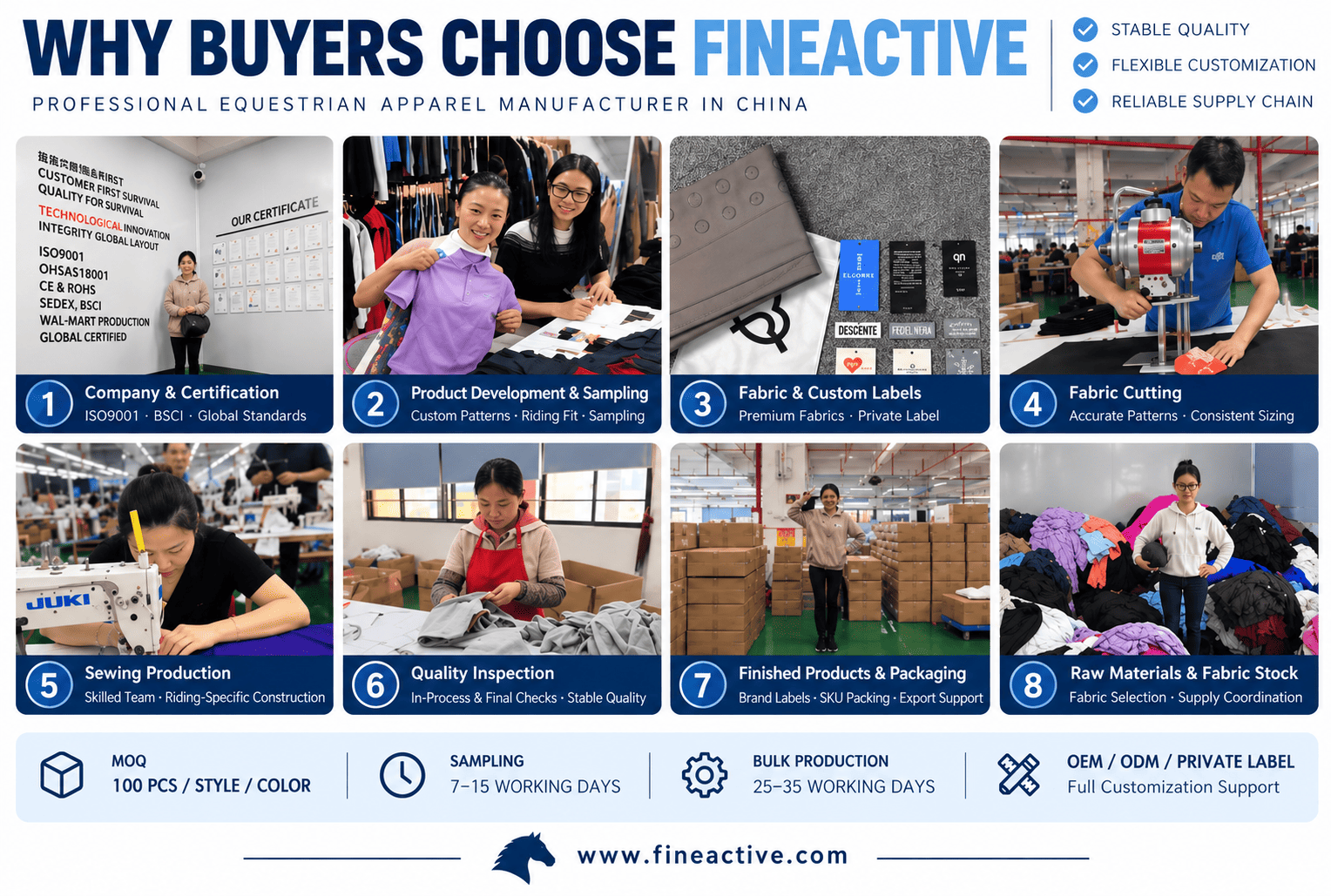
The best Chinese equestrian clothing manufacturer depends on the buyer’s business model, product range, purchasing volume, and sourcing priorities. Startup brands may prioritize manageable minimum orders, growing DTC brands often need reliable replenishment, premium labels require stronger product evidence, and equestrian retailers may benefit from broader supplier catalogs. Fineactive, RunEquestrian, SGL Sports, Equifactory, Zest Equestrian, and other suppliers in this comparison offer different potential advantages. Rather than choosing a manufacturer solely by ranking, buyers should shortlist companies whose published product focus and commercial model match their requirements.
Which Manufacturers Are Worth Comparing for Startup Equestrian Clothing Brands?
Startup brands typically face two major purchasing challenges: limited initial budgets and uncertain demand.
A new equestrian clothing business may want to launch a small collection, evaluate customer response, and expand gradually rather than commit to large quantities across multiple styles.
For this type of buyer, the most relevant factors are minimum order requirements, product specialization, development expenses, and the total cost of the first order.
Manufacturers worth comparing include Fineactive, RunEquestrian, and Kala Active.
| Manufacturer | Why It May Be Relevant | What Startups Should Confirm |
|---|---|---|
| Fineactive | Published 100-piece minimum per style per color and dedicated riding apparel focus | Total quantity across colors, initial development costs |
| RunEquestrian | Published offers starting from 100 pieces per style and equestrian clothing specialization | Current MOQ for the selected garment and color |
| Kala Active | Broad apparel development positioning and equestrian product coverage | Product-specific MOQ and complete quotation |
A lower MOQ can reduce the quantity of inventory a startup needs to purchase, but it does not automatically make the first order affordable.
For example, a brand planning three riding breeches colors should calculate its total required units rather than evaluate the minimum for a single color.
Startups should also consider whether the manufacturer can support future repeat orders without changing the approved product unexpectedly.
The strongest startup supplier is one whose minimum order structure and total commercial terms fit the brand’s launch budget.
Which Manufacturers Suit Growing DTC Equestrian Apparel Brands?
Direct-to-consumer equestrian brands often develop more demanding sourcing requirements as their businesses grow.
A brand that initially sells one successful riding breeches design may later introduce additional colors, seasonal collections, competition apparel, or coordinated riding tops.
At this stage, the purchasing challenge shifts from launching products to maintaining availability and consistency.
Brands planning to expand their riding apparel collections can also explore horse riding clothing manufacturing options when assessing potential production partners.
Fineactive, Equifactory, SGL Sports, and Shuyu Activewear are relevant candidates for comparison.
| Manufacturer | Published Product Positioning | Potential Buyer Advantage |
|---|---|---|
| Fineactive | Specialized equestrian apparel | Relevant for expanding riding clothing collections |
| Equifactory | Equestrian clothing and collection supply | Broad riding apparel assortment |
| SGL Sports | Equestrian clothing and general performance sportswear | Relevant for brands combining riding wear and athletic apparel |
| Shuyu Activewear | Equestrian clothing and multi-category activewear | Relevant for brands expanding into adjacent performance clothing categories |
Growing DTC brands should compare more than initial pricing.
They need to understand whether a supplier can maintain product specifications across successive orders, communicate changes clearly, and support realistic inventory planning.
For example, a brand selling both riding tights and fitness leggings may find a multi-category activewear manufacturer commercially relevant.
A business focused exclusively on technical riding apparel may prefer to compare suppliers whose catalogs concentrate on equestrian clothing.
Neither approach is automatically superior.
The better choice depends on the products the brand intends to sell over the next several seasons, not just its first purchase order.
Which Suppliers Should Premium Equestrian Clothing Brands Consider?
Premium equestrian apparel brands often place particular emphasis on garment consistency, material performance, appearance, and the experience of the end customer.
However, premium positioning should not be judged solely by a manufacturer’s marketing language or product photographs.
Buyers need to evaluate whether the supplier can meet the specifications and quality expectations associated with the intended retail price.
Fineactive, Equifactory, RunEquestrian, and RW Equestrian are reasonable candidates for an initial premium-apparel shortlist based on their published product ranges.
Their suitability should then be established through direct product evaluation.
| Manufacturer | Relevant Product Focus | Main Evaluation Priority |
|---|---|---|
| Fineactive | Riding breeches, competition clothing, and technical riding apparel | Consistency across the proposed apparel collection |
| Equifactory | Riding apparel and coordinated equestrian collections | Relevant garment samples and production evidence |
| RunEquestrian | Breeches, competition apparel, and riding teamwear | Performance of comparable riding garments |
| RW Equestrian | Riding clothing and seasonal outerwear | Quality consistency across garment categories |
For premium labels, it is particularly important to compare samples under equivalent conditions.
A supplier offering an attractive garment at a low price may not provide the best value if it cannot meet the required specifications consistently.
Conversely, a higher quotation does not automatically indicate better quality.
Premium brands should select manufacturers based on demonstrated suitability for their intended products, not assumptions about price or company reputation.
Which Chinese Suppliers Are Suitable for Riding Clubs and Equestrian Teams?
Riding clubs, training schools, and equestrian teams often have purchasing requirements that differ from those of retail apparel brands.
They may need coordinated clothing for members, instructors, competitors, or event participants.
Order planning can be influenced by team size, garment assortment, delivery deadlines, and the need to accommodate different body sizes.
Manufacturers worth comparing include RunEquestrian, Fineactive, SGL Sports, Zest Equestrian, and OpeEquestrian.
These companies cover different combinations of riding apparel, sportswear, and wider equestrian products.
How Should Clubs Compare Suppliers?
| Club Requirement | Main Supplier Consideration |
|---|---|
| Coordinated riding apparel | Relevant garment assortment and consistency |
| Multiple sizes | Size availability and minimum quantities |
| Competition deadlines | Confirmed production and shipping schedule |
| Member replenishment | Repeat-order terms and product continuity |
| Clothing plus horse products | Whether the supplier covers both categories |
| Budget management | Complete order cost and quantity requirements |
A club ordering only riding shirts and breeches may prefer a clothing-focused supplier.
A larger equestrian organization purchasing rider apparel alongside horse-related products may find a broader supplier more convenient.
However, a wide product catalog should not replace verification of the specific garments being purchased.
For clubs and teams, dependable delivery and an order structure that matches membership needs are often more important than the number of products advertised.
Which Manufacturers Fit Multi-Category Equestrian Retailers and Distributors?
Multi-category equestrian retailers may purchase riding apparel alongside saddle pads, horse rugs, and other equestrian products.
Their sourcing requirements can therefore differ significantly from those of clothing-only brands.
For these businesses, supplier breadth and purchasing coordination may influence the selection process.
Zest Equestrian, OpeEquestrian, and Hubei KDL are worth investigating for broader equestrian sourcing.
| Manufacturer | Published Business Focus | Potential Purchasing Benefit |
|---|---|---|
| Zest Equestrian | Rider apparel and horse products | Wider equestrian assortment |
| OpeEquestrian | Riding clothing and horse equipment | Multiple product categories |
| Hubei KDL | Equestrian clothing and related products | Additional supplier option for broader sourcing research |
These companies may be relevant when buyers want to reduce the number of suppliers involved in a purchasing program.
However, combining several product categories with one company does not guarantee that every category is manufactured at the same facility.
Buyers should confirm the production arrangements, minimum quantities, and quality responsibilities for each product group.
For a retailer whose main business is riding clothing, a specialist apparel manufacturer may still be more appropriate.
Supplier consolidation is valuable only when it supports reliable product quality, transparent commercial terms, and efficient purchasing.
Should Equestrian Brands Use One Manufacturer or Multiple Suppliers?
Choosing between a single manufacturing partner and multiple suppliers is an important sourcing decision.
A single supplier may simplify communication and purchasing coordination.
Multiple suppliers can provide access to different product specializations and reduce dependence on one manufacturing relationship.
Neither strategy is automatically better.
Single Supplier vs Multiple Suppliers
| Sourcing Model | Potential Advantages | Potential Limitations |
|---|---|---|
| One manufacturer | Simpler coordination, fewer supplier relationships, potentially easier order management | Greater dependence on one supplier’s capacity and performance |
| Multiple manufacturers | Access to specialized capabilities, alternative capacity, reduced supplier concentration | More complex communication, quality coordination, and purchasing administration |
| Primary supplier plus backup | Continuity with an alternative sourcing option | Additional qualification and supplier management costs |
A startup may initially prefer one qualified manufacturer because it has limited resources for managing several suppliers.
An established brand may choose a primary apparel manufacturer while qualifying a second supplier for selected products or contingency planning.
A retailer selling both clothing and horse equipment may use different specialists for different categories.
When multiple factories produce similar garments, buyers should pay particular attention to differences in sizing, materials, appearance, and approved specifications.
The right sourcing structure depends on purchasing volume, product complexity, operational resources, and the consequences of supply disruption.
Buyer-Type Comparison: Which Manufacturers Should You Shortlist First?
The following table summarizes the supplier groups worth investigating for different purchasing requirements.
These are shortlist recommendations based on published product positioning and available commercial information, not independently verified rankings of manufacturing performance.
| Buyer Type | Manufacturers Worth Comparing | Primary Selection Priority |
|---|---|---|
| Startup riding clothing brand | Fineactive, RunEquestrian, Kala Active | Initial MOQ and total launch cost |
| Growing DTC equestrian brand | Fineactive, Equifactory, SGL Sports, Shuyu Activewear | Collection expansion and repeat-order suitability |
| Premium equestrian apparel label | Fineactive, Equifactory, RunEquestrian, RW Equestrian | Product evidence and consistency |
| Riding club or competition team | RunEquestrian, Fineactive, SGL Sports, Zest Equestrian | Assortment, sizing, and delivery commitments |
| Multi-category equestrian retailer | Zest Equestrian, OpeEquestrian, Hubei KDL | Product coverage and purchasing coordination |
| Equestrian and fitness apparel brand | SGL Sports, Shuyu Activewear, Kala Active | Experience across related clothing categories |
| Seasonal riding apparel retailer | RW Equestrian, Equifactory, Fineactive | Relevant garment range and seasonal capacity |
How Should Buyers Make the Final Supplier-Fit Decision?
A manufacturer can be suitable for one brand and unsuitable for another, even when both companies purchase similar riding garments.
For example, a startup and an established retailer may have different inventory budgets, purchasing schedules, and expectations for supplier capacity.
A useful final comparison should answer three questions.
Does the manufacturer specialize in the products the buyer needs?
Relevant product experience should carry more weight than a large but unrelated catalog.
Do the commercial terms fit the business model?
MOQ, complete cost, delivery arrangements, and repeat-order requirements should align with the buyer’s purchasing strategy.
Can the supplier support its claims with relevant evidence?
Product samples, factory information, commercial documents, and previous order performance are more useful than broad statements about manufacturing excellence.
For buyers comparing horse riding clothing manufacturers in China, these three questions help turn a broad supplier list into a focused purchasing decision.
The best supplier is not necessarily the largest manufacturer or the one offering the most services. It is the company whose demonstrated capabilities, commercial requirements, and product focus best match the buyer’s business.
7. How Do You Shortlist and Select the Best Chinese Equestrian Clothing Supplier?
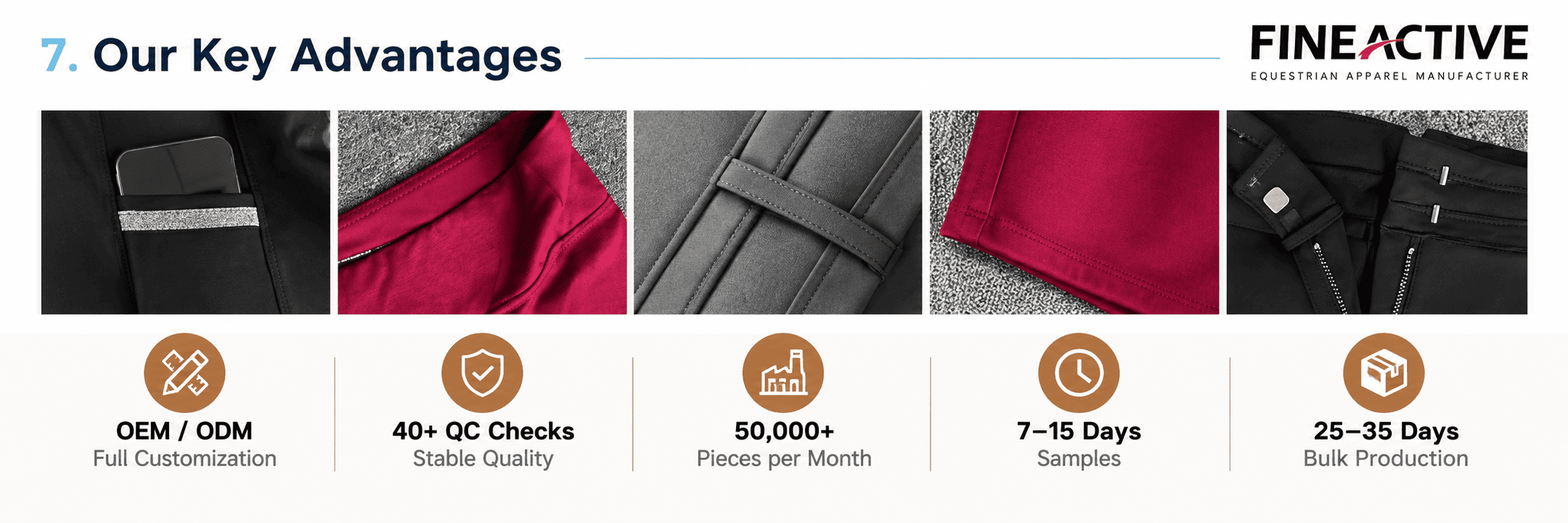
To select the best Chinese equestrian clothing supplier, narrow your initial manufacturer list to three qualified candidates, request comparable quotations, evaluate representative samples, and confirm all essential purchasing terms before placing an order. The final decision should reflect product suitability, total cost, delivery commitments, and commercial risk. A manufacturer that meets your requirements consistently may offer better long-term value than one providing the lowest initial quotation. The following selection process helps international equestrian brands turn supplier research into a practical purchasing decision.
What Is the Most Efficient Way to Shortlist Chinese Equestrian Clothing Manufacturers?
Comparing ten manufacturers provides a useful overview of the sourcing market, but requesting extensive development work from every supplier can be expensive and time-consuming.
A staged selection process helps buyers concentrate resources on the most relevant candidates.
Five Steps from Supplier Research to Final Selection
| Stage | Buyer Action | Expected Outcome |
|---|---|---|
| 1. Initial screening | Review the ten suppliers against essential product and purchasing requirements | Identify approximately five relevant candidates |
| 2. Commercial comparison | Request quotations based on identical specifications | Compare costs, quantities, and delivery terms |
| 3. Final shortlist | Select three suppliers with the strongest overall fit | Focus further evaluation on qualified candidates |
| 4. Sample evaluation | Compare representative garments against agreed requirements | Identify the strongest product and commercial options |
| 5. Final approval | Confirm contractual terms, production responsibilities, and order conditions | Select the preferred supplier and an appropriate backup |
The number of candidates can vary depending on the complexity and value of the purchase.
For example, a brand ordering an established garment may require less development work than a business launching a completely new collection.
The important principle is to apply consistent requirements throughout the selection process.
A smaller shortlist supported by meaningful evidence is more useful than a long supplier list with limited information.
How Should Buyers Compare the Final Three Manufacturers?
Once three suppliers have passed the initial screening, the next step is to compare their actual offers.
At this stage, buyers should avoid relying solely on general company descriptions.
Instead, each supplier should receive the same product requirements and be asked to provide a complete commercial proposal.
The final comparison should focus on the information that directly affects the purchasing decision.
Final Three-Supplier Decision Matrix
| Decision Factor | Supplier A | Supplier B | Supplier C |
|---|---|---|---|
| Product specifications accepted | Confirm | Confirm | Confirm |
| MOQ matches purchasing plan | Review | Review | Review |
| Complete quotation received | Review | Review | Review |
| Sample meets agreed requirements | Evaluate | Evaluate | Evaluate |
| Production schedule is acceptable | Confirm | Confirm | Confirm |
| Payment and shipping terms are clear | Confirm | Confirm | Confirm |
| Key risks are resolved | Assess | Assess | Assess |
| Final purchasing decision | Compare | Compare | Compare |
This matrix is intended to record actual supplier responses rather than assign predetermined rankings.
For example, Supplier A may provide the most competitive unit price but require a higher order quantity.
Supplier B may offer more suitable quantities but a longer production schedule.
Supplier C may have the strongest sample results but less favorable payment conditions.
The preferred supplier should offer the most appropriate overall balance for the brand’s requirements.
The final selection should be based on the complete purchasing arrangement, not one attractive commercial term.
What Should Be Included in a Final RFQ for Equestrian Clothing?
A request for quotation, or RFQ, should provide enough information for manufacturers to prepare comparable offers.
When buyers send different specifications to different factories, the resulting quotations may be difficult to evaluate fairly.
A consistent RFQ reduces misunderstandings and makes the final decision more efficient.
Essential Information for a Supplier RFQ
| RFQ Item | Information to Provide |
|---|---|
| Product category | Riding breeches, competition shirts, riding tights, jackets, or other garments |
| Product specification | Technical drawings, reference samples, measurements, and required materials |
| Estimated quantity | Expected units per style, color, and size |
| Branding requirements | Logo, labels, packaging, and other agreed details |
| Quality requirements | Approved specifications, relevant testing, and inspection expectations |
| Delivery destination | Country, port, or agreed delivery location |
| Target schedule | Required shipment date and relevant approval deadlines |
| Commercial requirements | Requested Incoterms, currency, and payment conditions |
Buyers should also ask suppliers to identify any assumptions used in preparing the quotation.
For example, a price may depend on a particular fabric being available, a minimum color quantity, or a specified packaging method.
If these assumptions are not recorded, the quoted price may change later.
A useful RFQ should therefore request confirmation of:
Total order quantity and minimum requirements.
Unit prices and any additional charges.
Sample and production timelines.
Quotation validity period.
Payment conditions.
Shipping terms.
Any exclusions or unresolved specifications.
The objective is to obtain quotations that can be compared on equivalent terms.
What Commercial Terms Should Be Agreed Before Placing an Order?
After selecting a preferred supplier, buyers should confirm the essential terms of the purchase in writing.
Clear documentation reduces the likelihood of disagreements about what was ordered, when it should be delivered, and how problems will be handled.
For international equestrian clothing orders, several areas deserve particular attention.
Key Purchase Order and Contract Considerations
| Contract Area | What Should Be Clearly Agreed |
|---|---|
| Product identification | Style numbers, approved specifications, colors, sizes, and quantities |
| Pricing | Unit prices, additional charges, currency, and quotation validity |
| Payment terms | Deposit, balance, payment timing, and beneficiary |
| Production schedule | Agreed milestones and shipment commitments |
| Delivery terms | Applicable Incoterms and responsibilities |
| Inspection arrangements | Inspection rights, acceptance criteria, and responsibilities |
| Product changes | Written approval requirements for substitutions or modifications |
| Defective goods | Procedures and remedies for nonconforming products |
| Confidentiality | Treatment of confidential business and product information |
| Dispute resolution | Agreed procedures and applicable contractual terms |
These terms should reflect the actual order rather than rely on general statements.
For example, a purchase order stating only “500 riding breeches” may leave important questions unanswered.
The parties should be able to identify which specifications, colors, sizes, and approved references apply.
Similarly, a production deadline should clarify whether it refers to factory completion, shipment readiness, or delivery to the buyer.
A clearly documented order provides a stronger basis for managing production and resolving disagreements.
For significant international transactions, qualified legal advice may be appropriate when preparing or reviewing contractual terms.
How Can Equestrian Brands Protect Their Designs and Commercial Information?
Private label equestrian brands may invest in original designs, garment patterns, branding, product development, and supplier relationships.
These assets can be commercially important, particularly when the brand is developing a distinctive product collection.
Before sharing sensitive information, buyers should consider how the manufacturer is permitted to use it.
Depending on the relationship, written agreements may address:
Ownership of original designs, artwork, and technical files.
Permitted use of brand names, logos, and trademarks.
Confidentiality of commercial and product information.
Restrictions on unauthorized reproduction or disclosure.
Ownership and permitted use of newly developed patterns or other deliverables.
Procedures for returning or handling confidential materials when cooperation ends.
A confidentiality agreement may be useful, but it should not be assumed to provide complete protection in every situation.
The effectiveness of intellectual property and confidentiality provisions depends on the applicable laws, agreement terms, and circumstances.
Buyers should also keep organized records of approved designs and communications.
Clear ownership and usage arrangements help reduce uncertainty before a manufacturer begins working with a brand’s proprietary information.
When Should Buyers Remove a Supplier from the Final Shortlist?
Not every concern requires immediate rejection.
A missing document or unclear quotation item may be resolved through further communication.
However, some issues create risks that are difficult to justify, even when a supplier offers attractive pricing.
Buyers should consider removing a supplier when important concerns remain unresolved.
Supplier Rejection Criteria
| Unresolved Issue | Why It Matters |
|---|---|
| Unverifiable business or payment identity | Creates uncertainty about the contracting party |
| False or misleading documentation | Undermines confidence in supplier representations |
| Repeated failure to meet agreed sample requirements | Indicates potential product suitability problems |
| Unapproved changes to product specifications | Creates quality and commercial uncertainty |
| Unclear responsibility for production | Makes accountability difficult |
| Refusal to document essential order terms | Increases the likelihood of disputes |
| Unrealistic delivery promises without supporting plans | Creates launch and inventory risks |
| Unresolved serious quality concerns | May expose the brand to defective products |
A supplier should not be selected simply because it remains the cheapest option after other candidates have been eliminated.
The final manufacturer must still meet the buyer’s essential requirements.
For example, if a factory cannot confirm who is responsible for producing the garments, an attractive price does not resolve the accountability problem.
Likewise, a supplier that repeatedly changes approved specifications may create unacceptable uncertainty for a brand requiring consistent products.
Price advantages should not override fundamental concerns about transparency, product suitability, or contractual responsibility.
What Should Buyers Confirm Before Paying a Production Deposit?
The final purchasing checkpoint should take place before a production deposit is transferred.
At this stage, the buyer should be able to confirm that the commercial offer, product requirements, and production responsibilities are consistent.
Final Pre-Order Checklist
Supplier and Commercial Information
The contracting company and payment beneficiary have been confirmed.
The final quotation includes all agreed charges.
MOQ, order quantities, and size distribution are documented.
Payment terms and delivery terms are agreed.
Product Approval
Final garment specifications are documented.
The approved sample or production reference is identified.
Colors, labels, packaging, and other order details are confirmed.
Any unresolved technical questions have been addressed.
Production and Delivery
Production milestones and responsibilities are clear.
The shipment deadline and applicable delivery terms are confirmed.
Inspection arrangements are agreed.
Procedures for changes, delays, and nonconforming goods are documented.
Business Protection
Confidentiality and relevant intellectual property terms are addressed.
The parties understand how disputes or major order problems will be handled.
Essential approvals and agreements are retained in writing.
Completing this checklist does not eliminate every manufacturing or commercial risk.
It does, however, reduce the chance of proceeding with an order based on incomplete information.
For brands placing their first international production order, these confirmations can be particularly valuable.
Final Recommendation: Choose the Supplier That Best Matches Your Purchasing Requirements
The ten horse riding clothing manufacturers in this guide represent different sourcing options within China’s equestrian apparel market.
Some concentrate on riding clothing, others manufacture broader performance apparel, and several supply both rider garments and horse-related products.
Their suitability depends on the buyer’s product category, order structure, commercial priorities, and ability to verify the proposed manufacturing arrangement.
A practical selection process begins with a broad comparison, narrows the list to three relevant candidates, and concludes with a documented evaluation of quotations, samples, and purchasing terms.
Brands evaluating a clothing-focused manufacturing partner can also review horse riding apparel manufacturing options when comparing specialized suppliers with broader sourcing companies.
The purpose of the final decision is not to identify a universally superior factory.
It is to select a manufacturer that can meet the brand’s requirements under clear, commercially sustainable conditions and provide a dependable basis for future orders.
Frequently Asked Questions About Horse Riding Clothing Manufacturers in China
1. Who Are the Best Horse Riding Clothing Manufacturers in China?
The best horse riding clothing manufacturers in China depend on the buyer’s product requirements, order volume, and sourcing priorities. Ten companies worth comparing are Fineactive, SGL Sports, Zest Equestrian, Equifactory, Kala Active, RunEquestrian, Shuyu Activewear, RW Equestrian, Hubei KDL, and OpeEquestrian.
These suppliers differ in their product focus, published minimum order quantities, and business models. Some specialize in riding apparel, while others manufacture broader sportswear collections or supply additional equestrian products. Buyers should evaluate relevant product experience, current commercial terms, and supporting manufacturing evidence before choosing a supplier. No single manufacturer is the best option for every purchasing situation.
2. Which Chinese Manufacturers Specialize in Equestrian Clothing Rather Than General Sportswear?
Fineactive and RunEquestrian are examples of Chinese suppliers whose published positioning focuses on equestrian apparel. Equifactory and RW Equestrian also offer riding clothing ranges, while SGL Sports and Shuyu Activewear manufacture equestrian garments alongside broader performance sportswear.
This distinction matters because different suppliers may have different levels of experience with riding-specific products. However, specialization alone does not guarantee better manufacturing performance. A general sportswear factory may still be suitable if it can demonstrate relevant production experience. Buyers should compare comparable garment samples and current manufacturing information rather than assume that a specialist automatically provides superior quality.
3. Are Chinese Equestrian Clothing Manufacturers Suitable for Premium Riding Apparel Brands?
Yes. Chinese equestrian clothing manufacturers can be suitable for premium riding apparel brands when they demonstrate the relevant product experience and consistently meet the buyer’s specifications. Manufacturing location alone does not determine whether a garment qualifies as premium.
Brands should evaluate finished samples, fit consistency, relevant performance evidence, and the supplier’s ability to reproduce approved products. They should also consider whether the manufacturer has experience with the intended garment category. A higher quotation or premium marketing presentation is not sufficient proof of superior quality. The strongest candidate is the supplier whose documented capabilities match the brand’s positioning and product expectations.
4. Is It Better to Buy Directly from a Chinese Factory or Through a Trading Company?
Buying directly from a Chinese factory may offer closer access to production information, while a trading company may help buyers coordinate multiple manufacturers or product categories. Neither model is automatically better.
The most important consideration is whether the supplier clearly identifies who produces the garments and who is responsible for quality, delivery, and commercial obligations. A trading company with reliable manufacturing partners may be appropriate for a retailer purchasing several categories. A clothing-focused brand may prefer a direct factory relationship. Buyers should choose the arrangement that provides suitable products, transparent responsibilities, and dependable communication.
5. Can Small Equestrian Brands Find Chinese Manufacturers for Their First Collection?
Yes. Small equestrian brands can find Chinese manufacturers offering relatively accessible initial order quantities, although minimums differ by supplier, product, and customization requirements. Published offers starting around 100 pieces are available for certain riding apparel products, but these conditions should not be assumed to apply across all factories.
For a first collection, buyers should consider the combined quantity required across styles, colors, and sizes. Development charges and other purchasing expenses also affect the initial investment. A suitable supplier should match the brand’s launch budget and provide a realistic basis for future orders if the collection performs well.
6. Which Chinese Equestrian Clothing Suppliers Offer the Broadest Product Ranges?
Zest Equestrian and OpeEquestrian are examples of suppliers whose published catalogs include both rider apparel and horse-related products. Hubei KDL also has a broader equestrian product business scope, although its current garment-specific offering requires further confirmation.
For buyers interested in riding clothing alongside saddle pads, horse rugs, or other equestrian goods, a broader supplier may simplify purchasing coordination. However, product variety does not necessarily mean that every item is manufactured at the same facility. Retailers should confirm production responsibilities, commercial terms, and product suitability separately for each category before consolidating purchases.
Get In Touch
Contact our OEM/ODM specialists for product development, sampling, pricing, and production support.